Pouch guide
Barrier Films and Laminates Explained
What PET, foil, metallised and kraft layers do, their thickness in microns and which products need them.
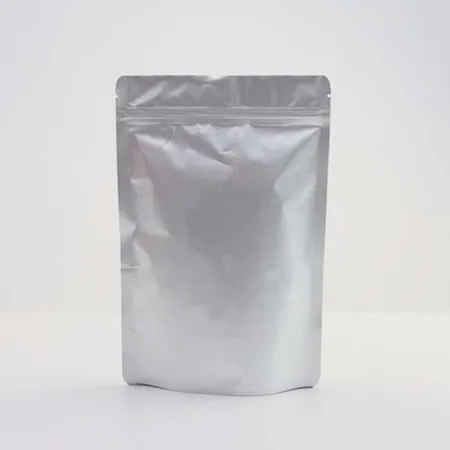
What is a laminate?
A pouch is never one film. It is two or three films glued together, each doing a job the others cannot. The outer layer takes the print and resists scuffing. The middle layer blocks oxygen, moisture and light. The inner layer melts under the sealing jaw to make the seal.
Written out, a laminate reads from outside to inside: PET / foil / PE means a polyester outer, an aluminium foil middle and a polyethylene inner. The slashes separate the layers.
Each layer has a thickness in microns. A micron is a thousandth of a millimetre. A typical three-layer coffee pouch is 100 to 120 microns in total, about the thickness of a sheet of printer paper.
What does each layer do?
PET, or polyester, is the outer film on most pouches. It is 12 microns thick, stiff, clear and glossy, and it takes print on its reverse side so the ink is protected under the film.
Aluminium foil, 7 to 9 microns, is the barrier. Nothing gets through it: not oxygen, not water vapour, not light. Metallised PET is a cheaper substitute, a PET film with a coating of aluminium a few hundred nanometres thick, which blocks most but not all of each.
Kraft paper, 50 to 80 gsm, is used as an outer layer for looks. PE, polyethylene, is the inner sealant at 60 to 100 microns, and it is also what carries the weight of the product.
| Laminate | Total thickness | Oxygen barrier | Moisture barrier | Light | Typical use |
|---|---|---|---|---|---|
| PET 12 / foil 8 / PE 80 | 100 to 120 microns | Very high | Very high | Blocked | Coffee, freeze dried, supplements, 12 to 24 months |
| PET 12 / metallised PET 12 / PE 70 | 95 to 110 microns | High | High | Blocked | Snacks, protein, sweets, 6 to 12 months |
| Kraft 60 / PET 12 / PE 70 | 110 to 130 microns | Low | Medium | Mostly blocked | Tea, granola, flour, 3 to 6 months |
| Kraft 60 / foil 8 / PE 70 | 120 to 140 microns | Very high | Very high | Blocked | Coffee with a paper look, 12 months |
| Clear PET 12 / PE 80 | 90 to 100 microns | Low | Medium | None | Sweets, pasta, pet treats shown through the pouch |
| Matte BOPP 20 / PE 70 | 85 to 95 microns | Low | Medium | None | Short-life snacks with a matte feel |
| PET 12 / foil 9 / CPP 70 | 95 to 110 microns | Very high | Very high | Blocked | Retort pouches cooked at 121 °C |
How is barrier measured?
Two numbers describe barrier. OTR, oxygen transmission rate, is the volume of oxygen that passes through a square metre of film in a day, in cubic centimetres. WVTR, water vapour transmission rate, is the grams of water vapour that pass through the same area in a day.
Foil laminates measure below 0.1 on both. Metallised films sit around 0.5 to 2 for oxygen and 0.5 to 1.5 for moisture. Clear PET / PE lets through 80 to 120 cc of oxygen and 5 to 10 g of moisture per square metre per day. Kraft / PET / PE is similar to clear.
You do not need the exact figures to choose a pouch. You need to know which group your product is in, which the next section covers. Where a product needs a certified barrier, a higher barrier film is an option we can quote on request.
Which products need which barrier?
Roasted coffee loses aroma to oxygen within weeks and goes stale within a few months in a poor barrier. It needs foil, and a valve. Anything with fat or oil, such as nuts, biscuits, kibble and protein with added fats, goes rancid in oxygen and needs foil or metallised film.
Freeze dried food and bath salts are moisture problems rather than oxygen problems. Both pull water from the air and go soft or clump. Foil is the safe choice for freeze dried food and metallised is enough for salts.
Sweets, pasta, rice and dried pulses are forgiving. A clear or kraft laminate is fine for a few months on the shelf. The foil stand up pouches cover the first group and the clear and kraft options cover the last.
- Foil: coffee, freeze dried food, supplements, anything needing 12 months or more
- Metallised: snacks, protein, sweets, pet treats, bath salts, 6 to 12 months
- Kraft / PET / PE: tea, granola, flour, oats, 3 to 6 months
- Clear PET / PE: products sold on sight with a short shelf life
- PET / foil / CPP: ready meals and pet food that are cooked in the pouch
Foil or metallised: how do you decide?
They look the same on the shelf, so the decision is about shelf life, cost and flex. Foil gives a near-total barrier and suits products that must last a year or more. Metallised costs less and suits six to twelve months.
Foil has one weakness. It cracks if the pouch is flexed hard and often, at the gusset fold or where a customer squeezes it. Each crack is a pinhole, and the barrier drops. Metallised film flexes better, which is why some snack brands choose it for pouches that get crushed in a lunchbox.
If the product is coffee, chocolate or anything with fat and a long shelf life, choose foil. If the pouch will be handled hard and the shelf life is under a year, metallised can be the better choice. A foil mylar bag in either build is quoted at the same time so you can compare.
What does kraft paper add and what does it cost you?
Kraft paper is a look, not a barrier. It is laminated on the outside of a PET / PE or foil / PE structure so the customer sees paper and the product sees plastic or foil.
Print on kraft is softer and darker than print on white film, so designs with pale colours need a white under-print. Paper also scuffs more easily and marks when wet.
The barrier depends entirely on what is behind the paper. Kraft / PET / PE is a low barrier; kraft / foil / PE is as good as any foil pouch. Ask which one you are being quoted.
Why is the inner PE layer so important?
The sealant layer makes every seal on the pouch, and it carries the weight. A thin PE layer on a heavy fill gives a weak bottom seal that splits when the pouch is dropped.
Thickness scales with weight. 60 to 70 microns of PE suits pouches up to 500 g. 80 to 100 microns suits 1 kg to 2 kg. Above that, a quad seal bag with 100 microns or more of sealant is the usual route.
The sealant also sets the sealing temperature. Standard PE seals at 120 to 160 °C with a dwell of 1 to 2 seconds on a bench sealer. Retort pouches use CPP instead, which seals at 170 to 210 °C and survives the cooking cycle. The retort pouches for cooked food are the only pouches on the site built that way.
How do you choose a laminate in five steps?
Start from the product and the shelf life, not from the look. The look is decided last and costs the least to change.
If two laminates would both work, choose the cheaper one and spend the saving on a thicker sealant or a better finish.
- Write down the shelf life you need: 3, 6, 12 or 24 months.
- Note whether the product has fat, aroma or is moisture-sensitive.
- Pick the barrier group from the list above: foil, metallised, kraft or clear.
- Set the sealant thickness from the fill weight: 60, 80 or 100 microns.
- Choose the outer look: white, clear, kraft, matte or gloss, and send it for a quote.
What mistakes do brands make with laminates?
The costly mistakes all come from choosing on looks. A kraft pouch chosen for a 12 month coffee without foil behind it. A clear pouch for nuts that go rancid in the shop window. A metallised pouch for freeze dried fruit that goes soft in two months.
The second group is thickness. A 1 kg pouch on a 60 micron sealant, or a 5 kg kibble bag on a laminate meant for 500 g.
- Kraft without foil for a long shelf life coffee
- Clear film for products with fat or oil
- Metallised instead of foil for freeze dried food
- Sealant too thin for the fill weight
- A window cut into a pouch that needed full barrier
- Standard PE in a pouch that goes through a retort or hot fill
How do you order the right film?
Tell us the product, the shelf life, the fill weight and the look you want. The laminate and its thickness are named on a written quote, priced from £0.25 a unit for the quantity you ask about.
Compostable, food-contact and higher barrier films are all options available on request and confirmed on the quote. Once the free proof is approved, making the pouches takes 4 to 6 business days, and the tracked UK delivery that follows is free and takes 2 to 3 business days.