Can energy gel pouches be opened with one hand?
Yes, with the pouch held in the fingers and the neck torn with the teeth. The notch and the laminate are set up so the tear runs straight.
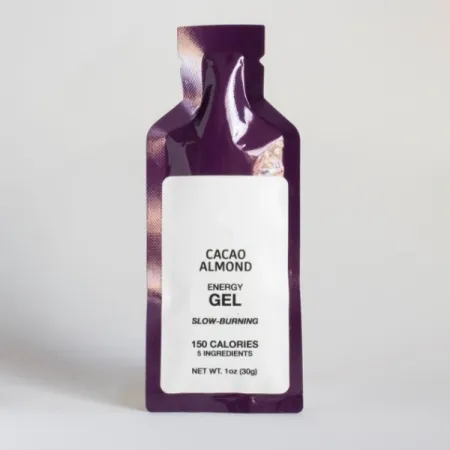
Quoted per order, from £0.25 a pouch
A shaped flat sachet with a narrow neck and a tear notch, made for a 30 to 60 g gel squeezed out on the move. Printed in your colours with the flavour and carbohydrate figure where a runner reads them.
The short version
Energy gel pouches are small shaped sachets, often bottle shaped, with a narrow neck that tears open at a notch so the gel can be squeezed straight into the mouth. Sports nutrition brands, honey producers and nut butter makers use them for single serves of 30 to 60 g. We make them to your fill weight and print them, with every detail confirmed on a written quote.
Key facts
| Spec | Standard | On request |
|---|---|---|
| Product | Energy Gel Pouches | Named variants quoted together |
| Range | Spout and Retort Pouches | Matching pouches across the range |
| Style and seals | Three side seal shaped sachet with a narrow neck; filled through the open bottom and sealed | Alternatives quoted on request |
| Typical laminate | PET / foil / PE or metallised PET / PE, around 90 to 110 microns in total | Alternatives quoted on request |
| Typical sizes and fills | Often 50 × 120 mm for 30 g, 60 × 140 mm for 45 g, 65 × 160 mm for 60 g | Alternatives quoted on request |
| Closure | Tear notch at the top of the neck; small spout and cap option for reclosing | Alternatives quoted on request |
| Window or valve | No valve; a clear strip is possible on a clear PET / PE laminate, on request | Alternatives quoted on request |
| How it ships | Flat, bottom open, in cartons ready for your filler and sealer | Alternatives quoted on request |
| Sizes | Cut to your fill weight or to the mm dimensions you send | Plain samples in the recommended size before a large run |
| Laminates | PET / foil / PE, metallised PET / PE or kraft / PET / PE, chosen for the product | Clear PET, BOPP or paper-feel films |
| Barrier | Matched to the product and the shelf life you tell us | High-barrier and food-contact film options, confirmed on the quote |
| Closures | Press-to-close zipper with a tear notch | Slider zipper, degassing valve, spout and cap, hang hole |
| Printing | Full colour digital with white under-print on foil and kraft | Plate print for long runs, spot colours and metallic inks |
| Finishes | Matte or gloss | Soft touch matte, spot gloss over matte, metallic effect |
| Windows | None | Clear or frosted, any shape inside the print area |
| Artwork | Vector PDF, AI or SVG placed on our dieline | We rebuild a PNG or JPG logo for print at no charge |
| Proof | Free, before anything is printed | As many revisions as it takes |
| Quantities | Priced for the number you ask for | A price ladder across three quantities |
| Fill weight | Size (W × H) | Good for |
|---|---|---|
| 30 g | 50 × 120 mm | Standard running gel, honey shot |
| 45 g | 60 × 140 mm | Gel with electrolytes, nut butter |
| 60 g | 65 × 160 mm | Double-dose gel, fruit puree for cyclists |
| 100 g | 75 × 180 mm | Race-day nut butter, larger drink gel |
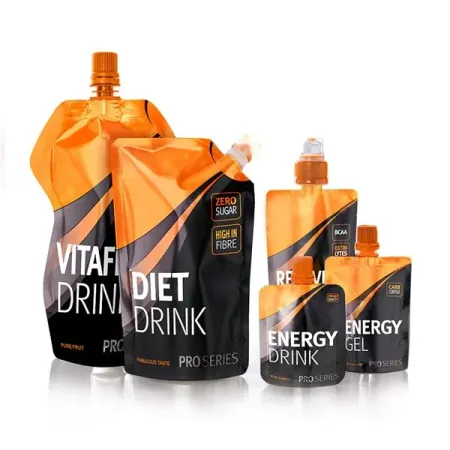
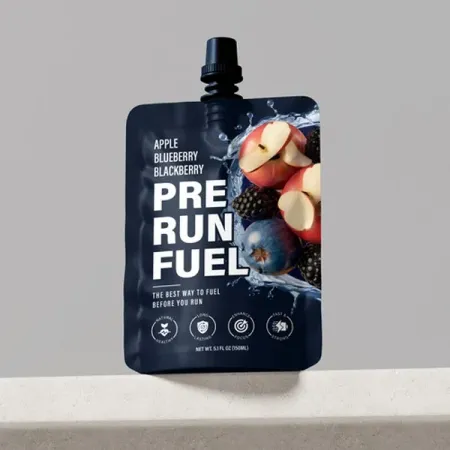
An energy gel pouch is a flat sachet with a shaped outline. The lower part is a wide body that holds the gel, and the top narrows into a neck a few millimetres across with a tear notch cut into it.
The runner tears the neck off, squeezes the body and the gel comes out in a controlled stream. There is no cap to lose and nothing to unscrew with cold or sweaty hands.
The shape is cut from a laminate after sealing. Bottle shapes are the most common, but a straight sachet with an angled corner notch does the same job and costs a little less to make.
Sports nutrition brands are the obvious buyers, from start-ups selling at parkrun events to companies supplying cycling clubs. Honey producers use the same pouch for a 30 g shot, and nut butter brands sell single serves for race day.
Straight unshaped versions sit alongside this pouch in our printed sachets for single portions, which suit powders and liquids that do not need a neck.
A 40 g gel usually fits a pouch around 55 × 130 mm, including the neck. The body needs to be wide enough that the gel flows to the neck when squeezed, and short enough to fit a jersey pocket.
Gels differ in density. A thin isotonic gel takes more room per gram than a thick maltodextrin gel, so the fill weight alone does not settle the size.
Send us the fill weight and a short description of the texture, or a sample, and we cut the dieline to suit. Our guide to choosing a pouch style covers the decision from product to pack.
Gels are mostly sugar and water. Lose water through the film and the gel thickens and can crystallise; let oxygen in and flavourings fade. A foil or metallised layer slows both.
The thin neck is the weak point for barrier, because it is all seal and very little body. A laminate around 90 to 110 microns gives the neck enough stiffness to tear cleanly.
Food-contact, high-barrier and compostable film options are available on request, confirmed on your quote. The layer-by-layer detail is in our laminate and barrier film guide.
The neck and notch are where the pouch either works on a run or does not. These are the options we cut.
| Neck style | How it opens | Suits |
|---|---|---|
| Bottle neck with notch at the tip | Tear across the neck, squeeze | Classic running gel |
| Angled corner notch on a straight sachet | Tear the corner off | Honey, nut butter, lower cost |
| Wide neck with notch | Tears to a larger opening | Thick gels and purees |
| Neck with small spout and cap | Unscrew, squeeze, reclose | Gels taken in two halves |
| Notch with a tear-direction line | Guided tear along a printed line | Brands that want a tidy opening |
Most runners grip the body between the fingers and tear the neck with their teeth. That works only when the notch is deep enough to start the tear and the laminate tears straight rather than wandering into the body.
The neck width matters as well. Too wide and the tear needs a hard pull. Too narrow and thick gel will not flow.
We cut the notch at the base of the neck tab and run the laminate so its tear direction follows the notch. Test pouches on your own gel settle the final geometry.
Pre-made gel pouches arrive bottom open. The gel goes in through that opening and the bottom is heat sealed, so the shaped neck is never near the filler.
A gel is read on the move, so the front panel needs three things large: flavour, carbohydrate grams and whether it carries caffeine. Everything else can be small on the back.
Bright colour coding by flavour helps a runner grab the right one from a pocket. Full colour digital print handles short runs of several flavours without a plate for each.
Leave the neck and seal edges free of fine text. Our designers place the artwork on the dieline and send a free proof, following the rules in our artwork guide for pouches and sachets.
The first is a neck too narrow for a thick gel. The runner tears it open, squeezes and gets a thin thread. We size the neck to the gel texture, not to the drawing.
The second is fine print across the neck. The tear goes straight through the nutrition panel and the customer cannot read it afterwards.
The third is sealing a warm gel without cooling. The pouch is packed warm, the gel settles and the bottom seal shows a wrinkle. Let the pouches cool flat before casing.
The same shaped sachet suits any thick product sold as a single serve. Beekeepers use it for a honey shot in a gift box, and nut butter brands fill it with 30 g for hikers and climbers.
Thin drinks are a different case. They need a cap so the pouch can be put down between sips, which is the job of our spouted drink pouches with a cap rather than a tear-off neck.
Send the fill weight, the gel texture, the neck style you want and the number of pouches. Quantities are quoted per order, from £0.25 per unit, confirmed on a written quote.
Our designers send a free design proof before printing. After approval, production takes 4–6 business days and free tracked delivery across the UK takes 2–3 business days.
Misprinted or damaged pouches reported within 10 days with photos are reprinted or refunded. The quickest start is the quote form for printed pouches or a WhatsApp with your artwork.
Four short steps: pick a real pouch photo, place your logo on it, choose the colour and finish, and send it. Our designers turn it into a free print-ready proof.
Fill weight, closure, barrier and quantity decide the price. Send what you know and a packaging specialist comes back within one business day with a written quote and a free design proof.
| Price | Quoted per order, from £0.25 a pouch |
|---|---|
| Proof | Free, before anything is printed |
| Production | 4–6 business days after proof approval |
| Delivery | Free and tracked across the UK, 2–3 business days |
| Materials | Food-contact, high-barrier and compostable film options available on request |
Something else? Call +44 7578 382054, message us on WhatsApp or email info@shopmylarbags.co.uk.
Yes, with the pouch held in the fingers and the neck torn with the teeth. The notch and the laminate are set up so the tear runs straight.
Common fills run from 30 g to 60 g. A 100 g pouch is possible for nut butter or a double-dose gel.
Sugar gels crystallise when they lose moisture. A foil laminate slows that loss, and your own shelf life testing sets the date.
Yes. A straight sachet with a corner notch tears from the side, which many honey and nut butter brands prefer.
Yes. Front and back print is standard, so the nutrition table, ingredients and allergens go on the back panel.
Yes. Honey is a common fill, and a 30 g honey shot in a shaped sachet sells well in farm shops and gift boxes.
Yes. A small spout and screw cap can replace the notch when the gel is taken in two halves.
Often 90 to 110 microns in total, enough to tear cleanly at the neck and to stand up to a jersey pocket.
A clear strip is possible on a clear PET / PE laminate, on request. Most gel brands stay with foil for the longer shelf life.
Yes. If you run a form fill seal machine, we print the film on rolls to your web width and repeat instead of supplying pre-made pouches.
Yes. The laminate thickness and the seal width are chosen so the pouch takes hours of rubbing in a jersey pocket without leaking.
No. A torn laminate edge is soft, which is why runners tear with their teeth without a problem.