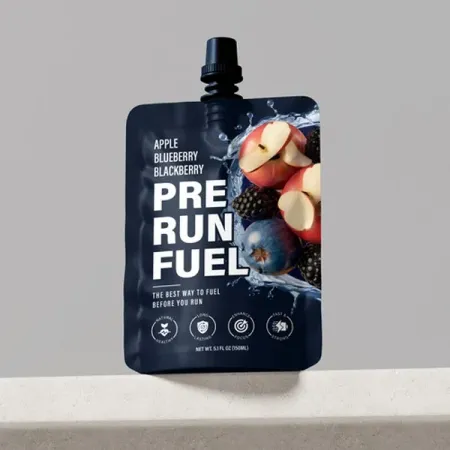
Do spout pouches arrive with the spout already fitted?
Yes. The spout is welded in and the cap is on. You fill through the open bottom or side seal, or through the spout on a spout filler.
Five pouches for products that pour, squeeze or cook in the pack. Spout pouches take a cap, retort pouches survive sterilisation at 121 °C, and chub packaging holds a soft product in a clipped tube.
5 productsQuoted per order, from £0.25 a pouchFree design proofFree tracked UK delivery
Most pouches on this site hold dry goods. These five hold liquids, gels, purees and cooked food, so the film, the seals and the fitments are all different.
A spout pouch has a plastic spout welded into the top or corner, with a screw cap. A retort pouch is sealed, then cooked in a pressure vessel. A chub is a tube of film clipped at both ends.
The table gives each one a job.
| Pouch | Best for | Key detail |
|---|---|---|
| Spout Pouches | Sauces, smoothies, baby food, liquid soap, bait liquids | Spout and screw cap welded into the top or corner seal |
| Retort Pouches | Ready meals, curries, rice, pet food in gravy | PET / foil / CPP laminate, sterilised at 121 °C after sealing |
| Drink Pouches | Juice, iced coffee, cocktails, sports drinks | Stand up pouch with a top spout or a straw hole |
| Energy Gel Pouches | 30 g to 60 g gels for runners and cyclists | Small flat or shaped pouch with a tear-off top or mini spout |
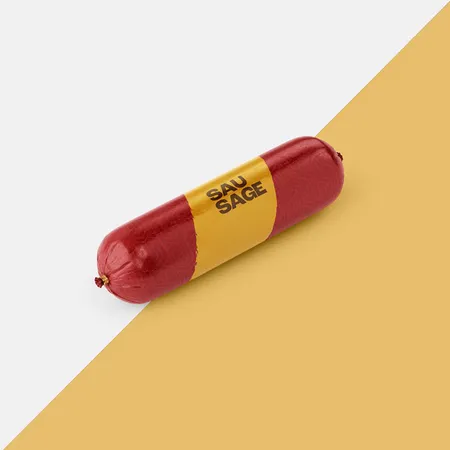
| Chub Packaging | Sausage, cookie dough, raw pet food, putty | Tubular film clipped at each end, filled by a chub machine |
Drinks brands come first: cold brew, juice, smoothies and ready-mixed cocktails sold at festivals and online. Baby food and fruit puree brands use the same spout pouch at 90 g to 120 g.
Ready meal producers, from curry kitchens to pet food makers, use retort pouches because the product keeps at room temperature after cooking in the pack.
Sports nutrition brands use gel pouches. Butchers, bakeries and raw pet food producers use chubs. The spout pouches with a screw cap are the entry point for most liquid products.
Spout pouches are sized in millilitres rather than grams, with the spout size chosen to suit the product. Thin liquids pour through an 8.6 mm spout. Purees and sauces need 10 mm or 16 mm.
Sizes below are common stand up spout pouches, measured width × height + gusset, with the spout centred in the top seal or set into a corner.
| Volume | A common size (W × H + gusset) | Spout |
|---|---|---|
| 50 ml | 70 × 120 + 35 mm | 8.6 mm, gels and shots |
| 100 ml | 90 × 150 + 45 mm | 8.6 mm or 10 mm, puree |
| 200 ml | 110 × 180 + 60 mm | 10 mm, drinks and sauce |
| 500 ml | 150 × 230 + 80 mm | 16 mm, sauce and soap |
| 1 litre | 180 × 290 + 100 mm | 16 mm, refills and bait liquid |
Liquids need a thicker inner PE layer than dry goods, 80 to 100 microns on its own, so the seals hold under the weight of the contents. PET / PE or PET / foil / PE are the usual builds for spout and drink pouches.
Retort is different. The inner layer is cast polypropylene, CPP, not PE, because PE softens at the 121 °C used to sterilise the pack. A typical retort build is PET 12 / foil 9 / CPP 70 microns.
Hot fill is a halfway house. Filling at 85 to 95 °C into a standard PET / foil / PE spout pouch works for sauces and juices that are then cooled fast. The retort pouches with a CPP inner layer page sets out when you need the full retort build. Higher barrier, food-contact and compostable films are quoted as options on request.
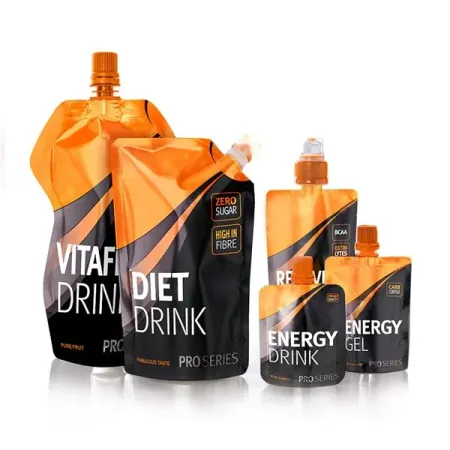
A drink pouch is a spout pouch built to be drunk from, not poured. The spout is at the top centre, the cap is small enough to hold in the mouth, and the pouch is usually 200 ml to 330 ml.
Some drink pouches skip the spout and use a straw hole: a weak point in the top seal that a straw pushes through. That is the lower cost version for children's juice and festival cocktails.
Clear film shows the colour of the drink, which sells juice and cocktails. The drink pouches with a top spout are offered clear, printed or foil with a window.
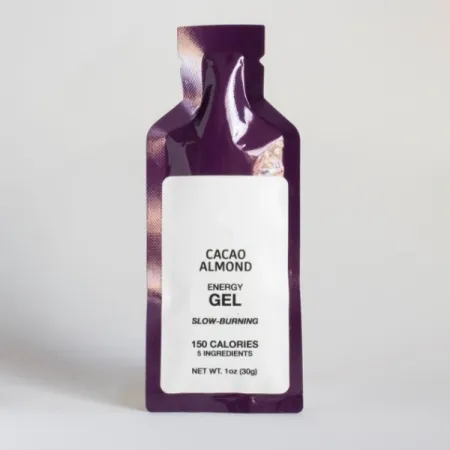
An energy gel pouch is small, 30 g to 60 g, and opened with one hand while moving. The tear-off top is the whole point. It must tear cleanly, every time, without the user needing to look.
Shaped pouches, like the tall slim shape in the photo, fit a cycling jersey pocket. Some brands use a mini spout with a cap so the gel can be taken in two goes.
Gels are thick and sweet, so the inner layer needs to resist sugar crystals and the pouch needs a wide enough neck. The energy gel pouches with a tear-off top are made to the shape and volume you specify.
A chub is a cylinder of film, filled by a machine that forms the tube, fills it and closes each end with a metal clip. Sausage meat, cookie dough, raw pet food and some putties and sealants are sold this way.
The film comes on a roll, printed with your design repeating along its length. There is no zipper and no spout. The customer cuts the end off.
Chub film is usually a PA / PE or PVDC-coated film, 60 to 90 microns, chosen for its strength and its barrier to oxygen. The chub packaging film with clipped ends is quoted by the roll and the number of chubs it will make.
Spouts come in 8.6 mm, 10 mm and 16 mm neck sizes. The number is the inside diameter of the spout. Caps are screw caps with a tamper band, or push-pull sports caps on drink pouches.
Corner spouts suit pouring, as the pouch can be tipped like a jug. Top centre spouts suit drinking and squeezing. Baby food brands use a rounded cap that is larger than the neck.
Retort pouches are plain sealed, with a tear notch, or fitted with a zipper for pet food that is used over two days. A chub has only its two clips.
Spout and drink pouches print in full colour on the front and back, with the gusset usually plain. Clear film takes a white block behind text so it reads against the liquid.
Retort pouches use inks that survive the 121 °C cycle. Plate print is the norm for retort because runs are large, though digital print is offered for trial batches.
Chub film prints as a repeat pattern along the roll. The repeat length is set by the chub length, so a 300 mm sausage has a 300 mm repeat. The design must still read when both ends are gathered into a clip.
Finishes on spout and drink pouches are usually gloss, which suits a drinks fridge. Matte and soft touch are offered for baby food and premium sauces, and spot gloss can pick out a logo on a matte pouch.
The spout size is the usual mistake. A thick puree will not pass an 8.6 mm spout and a thin drink pours too fast through a 16 mm one.
On retort, the error is ordering a standard PE laminate and finding the seals fail in the retort. On chubs, it is a repeat length that does not match the machine.
Send the product, its volume in millilitres, how thick it is and how it will be filled: cold, hot or retorted. Say whether the customer pours it, drinks it or squeezes it.
Pricing starts at £0.25 per unit and is confirmed in writing, with the quantity set per order. Our designers then draw the artwork onto the spout pouch dieline for a free proof, with the spout position marked.
Production is 4 to 6 business days from approval. Free tracked delivery to a UK address follows and takes 2 to 3 business days. Any misprint or transit damage reported inside 10 days with photos is reprinted or refunded.
Four short steps: pick a real pouch photo, place your logo on it, choose the colour and finish, and send it. Our designers turn it into a free print-ready proof.
Fill weight, closure, barrier and quantity decide the price. Send what you know and a packaging specialist comes back within one business day with a written quote and a free design proof.
| Price | Quoted per order, from £0.25 a pouch |
|---|---|
| Proof | Free, before anything is printed |
| Production | 4–6 business days after proof approval |
| Delivery | Free and tracked across the UK, 2–3 business days |
| Materials | Food-contact, high-barrier and compostable film options available on request |
Something else? Call +44 7578 382054, message us on WhatsApp or email info@shopmylarbags.co.uk.
Yes. The spout is welded in and the cap is on. You fill through the open bottom or side seal, or through the spout on a spout filler.
A 10 mm spout handles most purees. Very thick purees with pieces need 16 mm.
Yes. Retort pouches are made flat or as stand up pouches with a gusset, both in the PET / foil / CPP build.
Retort pouches are built for sterilisation at 121 °C for 30 to 60 minutes. Some builds reach 130 °C, which we confirm on the quote.
Yes, with the right film. Frozen cocktail and ice pop pouches use a PE-rich laminate that stays flexible when frozen, offered on request.
Most are 30 g to 60 g. The tall slim shape holds 40 g at about 45 × 130 mm.
As printed film on a roll. Your chub machine forms, fills and clips each chub.
Yes. Corner spouts are common on sauces and refills because the pouch pours like a jug.
Yes. Standard screw caps have a tamper band that breaks on first opening.
Yes. Clear PET / PE shows the product, with a printed white block behind the text. See the stand up pouches with a clear window if you want a window rather than a fully clear pouch.
Only if the pack is used over more than one meal. A press-to-close zipper above the tear notch is possible on retort builds.
Yes. A plain panel is left on the repeat for a coder to print the batch and date after filling.