Do side gusset bags stand up on their own?
Once filled, yes, with a softer and rounder shape than a flat bottom pouch. Empty bags lie flat.
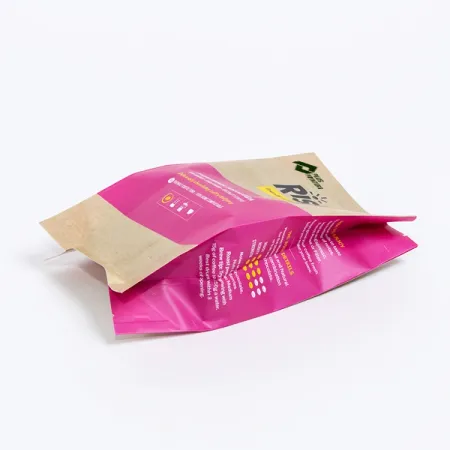
Quoted per order, from £0.25 a pouch
The classic coffee bag shape: a tall bag with two folded side gussets, a back seam and a top that folds over a tin tie or heat seals shut. Kraft, foil or full colour print, with a valve where the roast is fresh.
The short version
Side gusset bags are tall bags with a pleat folded into each side, a centre seam down the back and a sealed base. Filled, the gussets open and the bag stands with a rounded, soft shape. They are the traditional coffee and tea bag, closed with a tin tie, a heat seal or both.
Key facts
| Spec | Standard | On request |
|---|---|---|
| Product | Side Gusset Bags | Named variants quoted together |
| Range | Flat Bottom and Quad Seal Bags | Matching pouches across the range |
| Style and seals | Two folded side gussets, back centre seam, sealed base, open top | Alternatives quoted on request |
| Typical laminate | Kraft / PET / PE, kraft / foil / PE, PET / foil / PE or matte BOPP / PE | Alternatives quoted on request |
| Typical sizes | Often 80 × 250 + 50 mm (250 g) up to 150 × 400 + 90 mm (1 kg) | Alternatives quoted on request |
| Closure | Tin tie, heat seal, or fold-over top with a label; zipper on request | Alternatives quoted on request |
| Window or valve | One-way degassing valve on the front; window on request | Alternatives quoted on request |
| How it ships | Flat with gussets folded, tin ties fitted if ordered | Alternatives quoted on request |
| Sizes | Cut to your fill weight or to the mm dimensions you send | Plain samples in the recommended size before a large run |
| Laminates | PET / foil / PE, metallised PET / PE or kraft / PET / PE, chosen for the product | Clear PET, BOPP or paper-feel films |
| Barrier | Matched to the product and the shelf life you tell us | High-barrier and food-contact film options, confirmed on the quote |
| Closures | Press-to-close zipper with a tear notch | Slider zipper, degassing valve, spout and cap, hang hole |
| Printing | Full colour digital with white under-print on foil and kraft | Plate print for long runs, spot colours and metallic inks |
| Finishes | Matte or gloss | Soft touch matte, spot gloss over matte, metallic effect |
| Windows | None | Clear or frosted, any shape inside the print area |
| Artwork | Vector PDF, AI or SVG placed on our dieline | We rebuild a PNG or JPG logo for print at no charge |
| Proof | Free, before anything is printed | As many revisions as it takes |
| Quantities | Priced for the number you ask for | A price ladder across three quantities |
| Fill weight | Size (W × H + gusset) | Good for |
|---|---|---|
| 125 g | 70 × 200 + 40 mm | Tea, small coffee packs |
| 250 g | 80 × 250 + 50 mm | The standard retail coffee bag |
| 500 g | 100 × 310 + 70 mm | Whole bean, loose tea trade packs |
| 1 kg | 150 × 400 + 90 mm | Cafe coffee, dried fruit, bulk tea |
A side gusset bag is made from a single web of film folded into a tube with a seam down the back. A pleat is folded into each side, and the base is sealed flat.
When filled, the pleats open and the bag takes a soft rectangular shape with rounded edges. It is the bag most people picture when they think of a coffee bag.
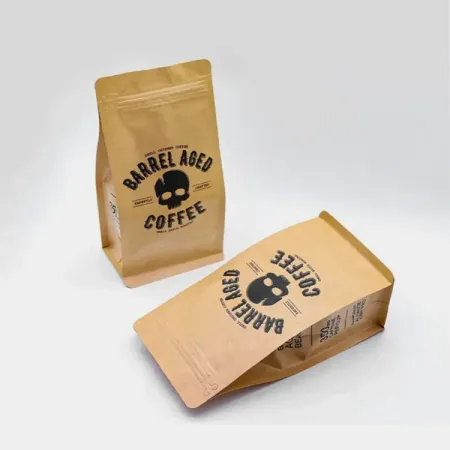
The top is left open for filling, then folded over a tin tie, heat sealed, or both, as the kraft bags in the photos show. Roasters comparing styles can see it next to the others on our coffee bags for roasters in every style.
Roasters who want the traditional look. Tea merchants with a heritage brand. Delis and farm shops packing dried fruit and nuts with a label on a plain kraft bag.
The reasons are practical as well as visual. A side gusset bag uses less film per gram of coffee than a stand up pouch, and it packs more tightly in a shipping carton.
Blenders who want a reseal rather than a tin tie usually choose our tea pouches with a zipper.
The classic 250 g coffee bag is about 80 mm wide and 250 mm tall with a 50 mm gusset each side. That leaves 60 to 70 mm of empty height at the top to fold over.
For 500 g go to 100 × 310 mm with a 70 mm gusset, and for 1 kg about 150 × 400 mm with a 90 mm gusset. Ground coffee fits a little smaller than whole bean.
Tea is lighter than coffee, so a 250 g tea bag is closer to the 500 g coffee size. Dried fruit is denser and fits the coffee sizes.
| Product and weight | Bag size | Top allowance |
|---|---|---|
| 250 g whole bean coffee | 80 × 250 + 50 mm | 60 mm fold or seal |
| 250 g ground coffee | 80 × 230 + 50 mm | 60 mm fold or seal |
| 250 g loose leaf tea | 100 × 300 + 70 mm | 70 mm fold or seal |
| 500 g dried fruit | 100 × 300 + 70 mm | 30 mm seal |
| 1 kg coffee for cafes | 150 × 400 + 90 mm | 80 mm fold or seal |
Plain kraft / PET / PE with a label, as in the first photo, is the lowest cost route for a small roaster or deli. The label carries the origin and date, and the bag never changes.
Kraft / foil / PE adds an aluminium layer behind the paper for a longer shelf life; it is the same structure as our paper laminate mylar bags with foil inside. PET / foil / PE in matte black or white gives a modern look while keeping the barrier.
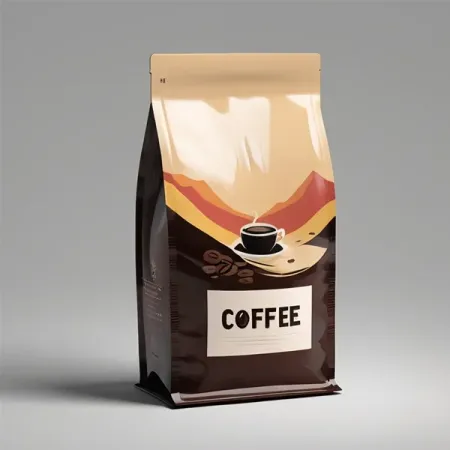
Full colour printed film, like the pink bag in the second photo, suits brands with several origins and a design that changes by blend. Ask for food-contact, high-barrier or compostable film options and the quote will state the structure.
A tin tie is a strip with two wires inside, stuck across the back of the bag near the top. The customer folds the top twice and bends the wires to hold it.
A heat seal across the top gives a tamper evident pack and keeps the barrier until first opening. Many roasters use both: a heat seal under the fold and the tin tie for reclosing.
A zipper can be fitted on request, but at that point most buyers move to our flat bottom pouches with a zipper, which carry one more neatly.
Freshly roasted coffee gives off carbon dioxide for days. Without a one-way valve the bag bloats and the seal or the tin tie fold gives way.
On a side gusset bag the valve sits on the front panel, in the top third, where the bag is flat and the customer can see it. It is fitted before the bag reaches you.
If you rest your coffee for two weeks before bagging, the valve is optional. If you bag within a few days, add it. Our guide on how degassing valves work on coffee bags explains the timing.
The front panel is tall and narrow, which suits a vertical logo and stacked text. The gussets take a repeat pattern or a single colour band.
The back carries a centre seam, so keep text 10 mm either side of it. Brew notes, origin and a batch area usually go on the back.
One colour black on kraft is the common choice. Full colour print on white or foil film is available, with a white under-print so colours stay true. Our artwork setup for printed pouches covers the seam allowance.
Filling is simple, but the fold-over top needs a method so every bag looks the same on the shelf.
Ordering the bag too short. The fold-over takes 60 to 80 mm of height; if you size to the coffee alone, there is nothing left to fold.
Expecting a plain kraft bag to hold coffee for months. Without a foil layer the aroma fades in weeks. Choose kraft / foil / PE for anything beyond a fortnight.
Leaving the valve off a fresh roast because the bag has a tin tie. The tin tie does not vent gas, and the bag bloats.
Printing the front at the wrong height for the fold. Artwork that sits in the top 70 mm disappears when the bag is folded over.
Tell us the product, the fill weight, kraft or foil, tin tie or heat seal, valve or not, and the quantity. Prices start from £0.25 per unit and the written quote confirms the figure.
Plain kraft bags with no print are quoted without a proof. Printed bags get a free design proof from our team, and production takes 4–6 business days once you approve it. Start by sending a quote request with your artwork or a photo of your current bag.
Delivery is free and tracked across the UK in 2–3 business days. Should a bag arrive misprinted or crushed, photos within 10 days bring a reprint or refund.
Four short steps: pick a real pouch photo, place your logo on it, choose the colour and finish, and send it. Our designers turn it into a free print-ready proof.
Fill weight, closure, barrier and quantity decide the price. Send what you know and a packaging specialist comes back within one business day with a written quote and a free design proof.
| Price | Quoted per order, from £0.25 a pouch |
|---|---|
| Proof | Free, before anything is printed |
| Production | 4–6 business days after proof approval |
| Delivery | Free and tracked across the UK, 2–3 business days |
| Materials | Food-contact, high-barrier and compostable film options available on request |
Something else? Call +44 7578 382054, message us on WhatsApp or email info@shopmylarbags.co.uk.
Once filled, yes, with a softer and rounder shape than a flat bottom pouch. Empty bags lie flat.
Yes. The tin tie is stuck across the back near the top before delivery, ready for folding after filling.
A one-way degassing valve is fitted on request. It is worth adding for coffee bagged within a few days of roasting.
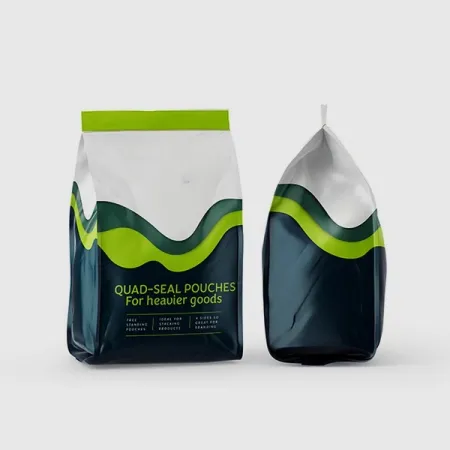
A quad seal bag adds a heat seal at each of the four corners so it stands square. A side gusset bag has no corner seals and a softer shape.
Yes. Loose leaf tea packs well in kraft / foil / PE side gusset bags at 100 g to 500 g, with a tin tie for reclosing.
Yes. Full colour digital or plate print on white, foil or kraft film, with a white under-print where colours need to stay true.
Yes, a clear or frosted window on the front panel. Dried fruit and nut packers use it; coffee bags usually stay closed to light.
On request, yes. For a reclosable retail bag most buyers choose a flat bottom pouch instead, which carries a zipper more neatly.
Allow 60 to 80 mm above the fill line for a fold-over top, or 30 mm for a heat seal only.
Not for long. Kraft / PET / PE without foil lets aroma out within weeks; choose kraft / foil / PE for a longer shelf life.
Per order, by size, laminate, closure, valve and quantity, from £0.25 per unit on a written quote.
Photograph it and tell us within 10 days; the bags are reprinted or the order refunded. The process is on our reprints and refunds page.