Can a retort pouch go in the microwave?
A foil retort pouch cannot. A non-foil retort laminate suitable for microwave reheating is available on request and confirmed on the quote.
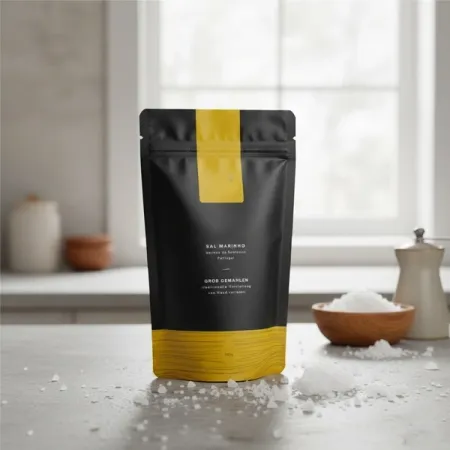
Quoted per order, from £0.25 a pouch
Flat or stand up pouches made from a laminate that goes through a pressure steriliser after filling and sealing. The food inside keeps at room temperature for months without a tin or a jar.
The short version
Retort pouches are flexible packs built from a laminate that withstands sterilising at around 121 °C once the pouch is filled and sealed. Curries, rice, soups, stocks and wet pet food are packed this way so they sit on an ambient shelf. We make them to your portion size and print them in your colours, with retort-grade films confirmed on a written quote.
Key facts
| Spec | Standard | On request |
|---|---|---|
| Product | Retort Pouches | Named variants quoted together |
| Range | Spout and Retort Pouches | Matching pouches across the range |
| Style and seals | Three side seal flat pouch or stand up pouch with bottom gusset; wide 8 to 10 mm seals | Alternatives quoted on request |
| Typical laminate | PET / foil / retort-grade sealant; a nylon layer added for drop resistance, confirmed on the quote | Alternatives quoted on request |
| Typical sizes and fills | Often 130 × 170 mm for 200 g, 160 × 230 mm for 400 g, up to catering packs around 3 kg | Alternatives quoted on request |
| Closure | Heat seal with tear notch; zippers are left off because they distort in the retort | Alternatives quoted on request |
| Window or valve | No valve; a window is possible only on retort-grade clear laminates, on request | Alternatives quoted on request |
| How it ships | Flat and top open in cartons, ready for your filler, sealer and retort | Alternatives quoted on request |
| Sizes | Cut to your fill weight or to the mm dimensions you send | Plain samples in the recommended size before a large run |
| Laminates | PET / foil / PE, metallised PET / PE or kraft / PET / PE, chosen for the product | Clear PET, BOPP or paper-feel films |
| Barrier | Matched to the product and the shelf life you tell us | High-barrier and food-contact film options, confirmed on the quote |
| Closures | Press-to-close zipper with a tear notch | Slider zipper, degassing valve, spout and cap, hang hole |
| Printing | Full colour digital with white under-print on foil and kraft | Plate print for long runs, spot colours and metallic inks |
| Finishes | Matte or gloss | Soft touch matte, spot gloss over matte, metallic effect |
| Windows | None | Clear or frosted, any shape inside the print area |
| Artwork | Vector PDF, AI or SVG placed on our dieline | We rebuild a PNG or JPG logo for print at no charge |
| Proof | Free, before anything is printed | As many revisions as it takes |
| Quantities | Priced for the number you ask for | A price ladder across three quantities |
| Fill weight | Size (W × H + gusset) | Good for |
|---|---|---|
| 200 g | 130 × 170 mm flat | Single portion sauce or soup |
| 300 g | 150 × 200 mm flat | Rice, dal and grain pouches |
| 400 g | 160 × 230 mm + 80 mm | Ready meal curry for one |
| 1 kg | 200 × 300 mm + 90 mm | Catering sauce base |
| 3 kg | 300 × 400 mm flat | Bulk stock or wet pet food |
A retort pouch is filled, sealed and then cooked inside its own pack. The sealed pouch goes into a pressure vessel, the retort, where steam or hot water holds it at around 121 °C for long enough to sterilise the food.
That step is what sets it apart from a normal pouch. An ordinary PE seal layer softens at those temperatures and the seals fail, so a retort pouch uses a sealant made for the job.
Because the food is sterilised in the pack, the pouch does no more work on shelf than a tin. The customer opens it at the tear notch, heats the contents and eats.
Anything wet that would once have gone in a can. UK meal brands, Indian and Thai sauce makers and pet food producers are the main buyers, along with outdoor meal companies and caterers.
The full set of heat-processed and spouted styles sits in our retort and spout pouch range for comparison.
Three things happen in the retort: heat, pressure and steam. Each layer of the pouch has to hold its shape and its bond through all three, then cool without delaminating.
The outer PET layer carries the print and takes the heat. The foil in the middle blocks oxygen and light so the sterilised food stays stable. The inner sealant layer, usually cast polypropylene rather than PE, makes the seal and survives the cycle.
Retort-grade, food-contact and high-barrier films are available on request and confirmed on your quote. The job of each layer is set out in our barrier films and laminates guide.
Both shapes go through the same process. The choice comes down to where the pouch is sold and how it is heated at home.
| Shape | Strengths | Watch for |
|---|---|---|
| Three side seal flat pouch | Thin profile heats evenly, stacks flat in a carton | Lies down on shelf unless boxed |
| Stand up pouch with gusset | Stands on shelf, more front panel for print | Thicker product core takes longer to sterilise |
| Flat pouch with a slit for a sleeve | Sells in a printed sleeve | Needs a second supplier for the sleeve |
| Large flat catering pouch | Holds 1 kg to 3 kg for kitchens | Needs a wide seal bar on the line |
A 400 g single meal is often around 160 × 230 mm as a stand up pouch with an 80 mm gusset. A flat pouch for the same weight runs a little larger because it has no gusset to hold the volume.
The shape of the food matters as much as the weight. Rice packs densely, so a 300 g rice pouch is smaller than a 300 g pouch of stew with liquid.
Leave room above the fill line for the seal and for the small amount of expansion during the cycle. We size the pouch from your portion weight, your product density and your seal bar width.
Retort seals run wider than ordinary pouch seals, often 8 to 10 mm, so there is margin if a seal edge picks up a trace of sauce. A clean seal is still the goal, which is why many lines wipe the seal area before closing.
The tear notch is cut into the side seal above the fill. Customers open the pouch from there after heating, so it needs to sit where a hand can grip the pouch without squeezing the hot contents.
There is no zipper on a retort pouch. The plastic profile distorts in the steriliser and the pouch is eaten in one sitting anyway.
You need a filler, a heat sealer with a wide bar and access to a retort, either your own or a co-packer's. The sequence below is the one most small producers follow.
The ink is printed on the inside of the outer PET layer and then laminated, so it sits between film layers. Steam and handling never touch it, which is why retort print stays sharp after the cycle.
Plate print suits long runs of one design. Full colour digital suits several recipes in small volumes, where each flavour has its own front panel.
Keep a plain band around the tear notch and the seal edges, and send vector files where you can. Our guide to pouch artwork and dielines covers the rest, and our designers send a free proof.
Running an ordinary PE pouch through a retort is the expensive one. The seals open in the vessel and the batch is lost. Say retort on the brief and we quote the right film.
Overfilling is the second. A pouch with no headspace swells in the cycle and splits a seal, and a pouch with too much air floats in the tray and heats unevenly.
The third is sealing over product. A grain of rice in the seal makes a channel, and that channel lets air in weeks later. Wipe the seal area or fill through a nozzle that keeps it clean.
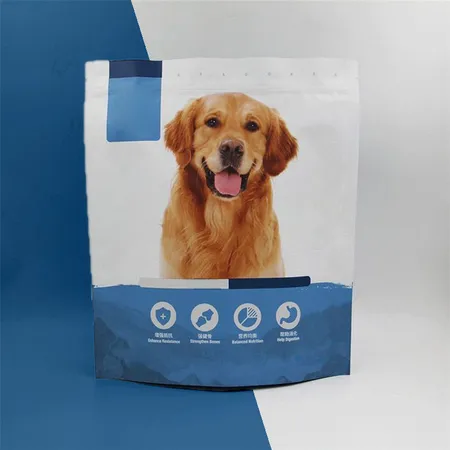
Wet cat and dog food moved from tins to pouches years ago, and small UK pet food makers now follow the same route. A 100 g flat pouch is a common single-meal size for cats.
Dog food runs larger, often 150 g to 400 g, and a stand up shape helps the pack sit on a pet shop shelf. Pouches for dry treats and kibble need a zipper instead and are a different product on our pet food pouches for treats and kibble page.
Tell us the portion weight, the recipe type, whether it is flat or stand up and roughly how many you need. Include your sealer bar width and your retort cycle if you know them.
Quantities are quoted per order, from £0.25 per unit, confirmed on a written quote. You approve a free design proof, then production takes 4–6 business days and free tracked UK delivery takes 2–3 business days.
Misprints or damage reported within 10 days with photos are reprinted or refunded. Send the brief through the written quote request page, by email or on WhatsApp.
Four short steps: pick a real pouch photo, place your logo on it, choose the colour and finish, and send it. Our designers turn it into a free print-ready proof.
Fill weight, closure, barrier and quantity decide the price. Send what you know and a packaging specialist comes back within one business day with a written quote and a free design proof.
| Price | Quoted per order, from £0.25 a pouch |
|---|---|
| Proof | Free, before anything is printed |
| Production | 4–6 business days after proof approval |
| Delivery | Free and tracked across the UK, 2–3 business days |
| Materials | Food-contact, high-barrier and compostable film options available on request |
Something else? Call +44 7578 382054, message us on WhatsApp or email info@shopmylarbags.co.uk.
A foil retort pouch cannot. A non-foil retort laminate suitable for microwave reheating is available on request and confirmed on the quote.
The zipper profile softens and distorts at sterilising temperatures, and the pouch is normally eaten in one go, so a tear notch does the job.
That is set by your recipe, your retort cycle and your own shelf life testing, not by the pouch alone. We choose the laminate to support the life you ask for.
You need access to one, either on site or at a co-packer. The pouch is only shelf stable after it has been through the cycle.
Yes. Full colour plate or digital print is laminated between the film layers, so the design is protected during sterilising.
Yes. The ink sits under the outer PET layer, so steam and water never reach it. Colour stays as it was on the proof.
Yes. An 85 g or 100 g flat pouch is a common cat food portion. Tell us the weight and whether you want a stand up shape.
Often 8 to 10 mm, wider than a standard pouch. Tell us your sealer bar width and we match the seal area to it.
Yes, with a bottom gusset. Flat three side seal pouches lie down unless they are sold in a sleeve or a tray.
A clear retort laminate without foil is possible on request. It shows the food but gives a shorter shelf life than a foil pouch.
Catering pouches around 3 kg are a common upper size. Tell us the fill weight and we confirm the dimensions on the quote.
No. Many brands sell a stand up retort pouch on its own, while flat pouches often go in a sleeve so they stand on the shelf.