Can a printed flat pouch be posted through a letterbox?
Yes, when the filled thickness stays under about 25 mm. Spread the product flat before sealing.
Quoted per order, from £0.25 a pouch
Flat pouches printed on the front and back, with no gusset, so the whole pack is one clean printed surface. Sized from a 10 g sample sachet to a 500 g bag, with hang hole or zipper options.
The short version
Printed flat pouches are two-panel pouches without a gusset, printed on the front and the back. They are the lightest and thinnest pouch shape, used for samples, single portions, tea, sweets and small coffee packs. Filled thin, they post through a letterbox.
Key facts
| Spec | Standard | On request |
|---|---|---|
| Product | Printed Flat Pouches | Named variants quoted together |
| Range | Flat and Three Side Seal Pouches | Matching pouches across the range |
| Style and seals | Flat two-panel pouch, sealed on three sides with the top open for your sealer | Alternatives quoted on request |
| Typical laminate | PET / PE, matte BOPP / PE or PET / foil / PE; clear back on request | Alternatives quoted on request |
| Typical sizes | Often 70 × 100 mm for 10 g samples up to 180 × 260 mm for 500 g | Alternatives quoted on request |
| Closure | Heat seal; zipper and tear notch on request | Alternatives quoted on request |
| Window or hang hole | Round or euro slot hang hole; clear window on non-foil builds | Alternatives quoted on request |
| How it ships | Flat in stacks, top open | Alternatives quoted on request |
| Sizes | Cut to your fill weight or to the mm dimensions you send | Plain samples in the recommended size before a large run |
| Laminates | PET / foil / PE, metallised PET / PE or kraft / PET / PE, chosen for the product | Clear PET, BOPP or paper-feel films |
| Barrier | Matched to the product and the shelf life you tell us | High-barrier and food-contact film options, confirmed on the quote |
| Closures | Press-to-close zipper with a tear notch | Slider zipper, degassing valve, spout and cap, hang hole |
| Printing | Full colour digital with white under-print on foil and kraft | Plate print for long runs, spot colours and metallic inks |
| Finishes | Matte or gloss | Soft touch matte, spot gloss over matte, metallic effect |
| Windows | None | Clear or frosted, any shape inside the print area |
| Artwork | Vector PDF, AI or SVG placed on our dieline | We rebuild a PNG or JPG logo for print at no charge |
| Proof | Free, before anything is printed | As many revisions as it takes |
| Quantities | Priced for the number you ask for | A price ladder across three quantities |
| Fill weight | Size (W × H) | Good for |
|---|---|---|
| 10 g | 70 × 100 mm | Tea samples, spice sachets, sweet gifts |
| 50 g | 100 × 150 mm | Gummies, protein sample, coffee taster |
| 100 g | 120 × 180 mm | Tea blends, whey protein single pack |
| 250 g | 150 × 230 mm | Coffee, dried fruit, biscuits |
| 500 g | 180 × 260 mm | Flour, oats, nuts |
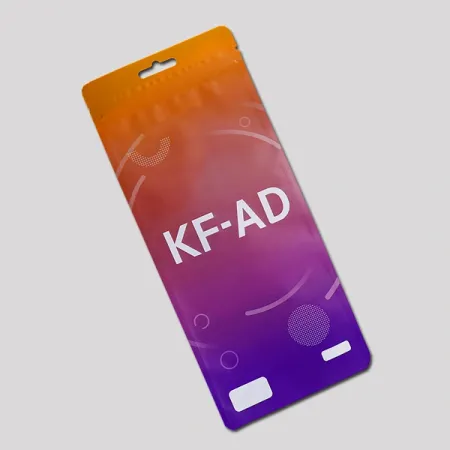
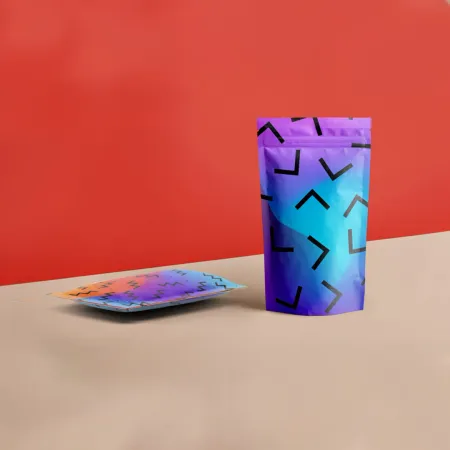
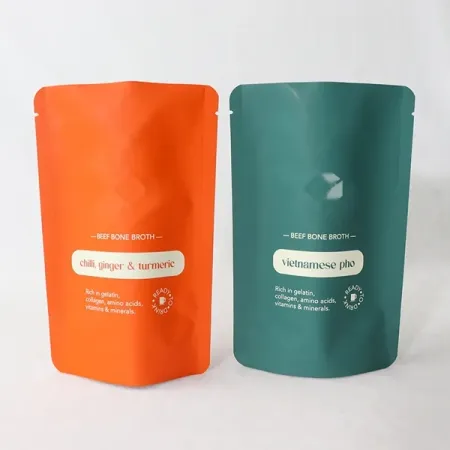
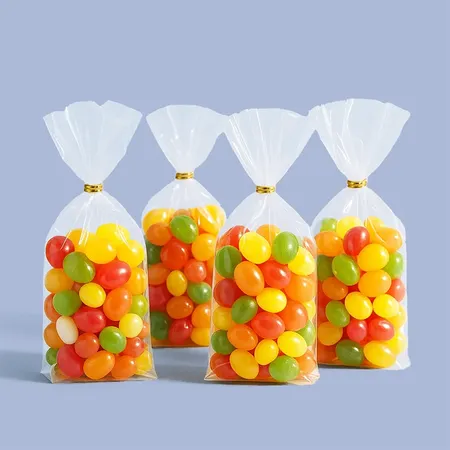
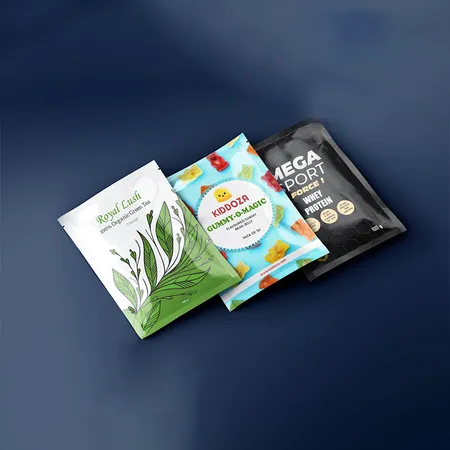
A flat pouch is two printed panels sealed together at the edges with no fold at the base. Filled, it is a slim pillow rather than a box. Our photos show a tea sachet, a gummy sweet pack and a 100 g whey protein pouch, then a frosted pouch with a hang hole, then two coffee pouches with a zipper and hang hole.
Both panels print, so the back is as useful as the front. Brands put the brewing method, the serving size or a second image there.
A flat pouch is usually sealed on three sides before it reaches you, with the top open. The focus on this page is different: both faces printed, and the thinnest possible pack.
It sits in our flat pouches collection for UK brands next to its three-side-sealed relative.
Brands that send samples, sell single portions or post goods through the letterbox.
Protein brands slip a 30 g flat sachet into every parcel as a taster for the next flavour, which costs less than a printed leaflet and gets used.
Tea sellers can compare shapes on the tea pouches page for blenders.
The flat pouch uses less film, weighs less and takes up less space in a box. It gives up the shelf presence of a gusseted pouch in return.
Postage is the deciding factor for subscription brands: a flat pack that fits through the letterbox avoids a missed delivery and a trip to the depot.
| Factor | Flat pouch | Stand up pouch |
|---|---|---|
| Film per pack | Least | More, for the gusset |
| Posting | Fits a letterbox when filled thin | Usually a parcel |
| Shelf display | Pegged or in a tray | Stands on its own |
| Print area | Two full panels | Front, back and gusset |
| Fill weights | 10 g to 500 g | 100 g to 2 kg |
A 100 g tea blend is bulky and needs around 120 × 180 mm. 100 g of whey is dense and fits 100 × 160 mm. 100 g of gummies lands between the two.
Flat pouches belly out when filled, so each panel loses about 10 mm of visible width. Keep the main artwork inside that.
Sweets are the easiest to size: 50 g of gummies sits in 100 × 150 mm with room for a hang hole, and the pack stays under 15 mm thick.
Posting through a letterbox usually means a filled thickness under 25 mm. Spread the product thin rather than deep, so a wider, shorter pouch suits postal packs. The pouch decision guide by product type helps if you are between two sizes.
PET / PE and matte BOPP / PE are the usual builds for sweets, tea and dry snacks. Coffee and protein samples use PET / foil / PE so the taster tastes the same as the full pack.
Flat pouches that go through the post take knocks. A thicker PE inner layer helps, and fragile products such as biscuits travel better in a padded outer.
Tea tasters in PET / PE lose aroma within weeks, so blenders who care about the first cup choose the foil build even for a 10 g sachet.
Food-contact, high-barrier and compostable films can be added as options on request; the quote states which. Our barrier film and laminate explainer covers the detail.
Two printed faces is the main reason to choose this pouch. A plan for each face keeps it tidy.
Short runs of several flavours print well on digital. Long runs of one design go to plate print or onto printed film rolls for form-fill-seal lines.
A hang hole in the top seal lets the pack hang by the till. A euro slot is the shape to ask for if your retailer uses double hooks.
A zipper below the top seal makes a 250 g coffee or sweet pack resealable, as in our third photo. Tear notches on both sides give the customer a clean start. All three are options confirmed on the quote.
Hang holes and zippers both take space from the printed face. On a 100 × 150 mm pouch, allow for a 25 mm band at the top before the artwork starts.
Sweet makers who want gifting shapes can look at printed sweet bags for confectioners.
Open the top, fill, press out the air you do not want, and seal across the top. Flat pouches sit evenly on an impulse sealer, so a bench operator can run several hundred an hour.
Keep the seal strip free of powder. For protein samples, fill through a paper funnel and tap the pouch so powder settles before sealing.
If you flush with nitrogen or vacuum seal, tell us and we adjust the top strip height for your machine.
A date or batch code can be stamped into the top seal by most band sealers, which saves a label on a small pack.
Treating a flat pouch like a stand up and expecting it on a shelf. It leans or falls over.
Choosing a gloss finish for a pouch that goes through the post. Gloss shows every scuff from a sorting machine; matte hides them.
Over-filling for the letterbox. A 250 g pack of beans is not a letterbox pack. Keep it to 100 g and spread it thin.
Forgetting the back. Brands approve a beautiful front and a blank back, then stick a label on later that spoils the look.
Tell us the product, weight, number of designs and whether you want a hang hole or zipper, by form, email or WhatsApp. Each quantity is priced per order, from £0.25 per unit, and confirmed in writing.
A free proof shows both faces. Production takes 4–6 business days after approval, and free tracked delivery reaches any UK address in 2–3 business days.
Any misprint or damage reported within 10 days with photos is reprinted or refunded. Use the quote form for printed pouches to start.
Four short steps: pick a real pouch photo, place your logo on it, choose the colour and finish, and send it. Our designers turn it into a free print-ready proof.
Fill weight, closure, barrier and quantity decide the price. Send what you know and a packaging specialist comes back within one business day with a written quote and a free design proof.
| Price | Quoted per order, from £0.25 a pouch |
|---|---|
| Proof | Free, before anything is printed |
| Production | 4–6 business days after proof approval |
| Delivery | Free and tracked across the UK, 2–3 business days |
| Materials | Food-contact, high-barrier and compostable film options available on request |
Something else? Call +44 7578 382054, message us on WhatsApp or email info@shopmylarbags.co.uk.
Yes, when the filled thickness stays under about 25 mm. Spread the product flat before sealing.
Both faces are printed as one sheet, so a printed back adds nothing beyond artwork time. The quote shows the full figure.
Around 50 × 80 mm for a single teaspoon of product. Anything smaller runs as a printed sachet.
Yes, on PET / PE and BOPP / PE builds the window is left clear in the print. Foil builds have no window.
Yes for tasters and 100 g to 250 g packs, with a foil layer and a valve on request for freshly roasted beans.
Yes. The two faces are separate artwork areas, and both appear on the proof.
Flat pouches are open at the top for your filling line. Sachets are usually sealed on all four sides by a filling machine.
Yes. A clear back with a printed front is an option on request, so the product shows from behind.
Yes. A press-to-close zipper below the top seal and tear notches on both sides make it resealable.
Pre-made flat pouches suit bench and semi-automatic fillers. For high-speed form-fill-seal machines, ask about printed film rolls.
Matte, gloss, soft touch matte or spot gloss over matte, chosen when you request the quote.
Yes. Each size is quoted as its own line, and the artwork is resized to each dieline by our designers for free.