Do I pay for the cutting die on a die cut mylar bag?
The die is priced on your quote with the bags. We tell you the figure before you approve anything, and the die is kept for your repeat orders.
Quoted per order, from £0.25 a pouch
Flat foil pouches cut to a shape instead of a rectangle: a circle, a panda face, a pumpkin, a bottle outline. Printed edge to edge and heat sealed round the outline, so the bag itself becomes the product shape on the shelf.
The short version
Die cut mylar bags are flat, heat sealed foil pouches cut to a custom outline with a steel cutting die after printing. The seal follows the shape a few millimetres inside the cut edge. They suit single-serve sachets, face masks, sweets and promotional packs where the shape does the selling.
Key facts
| Spec | Standard | On request |
|---|---|---|
| Product | Die Cut Mylar Bags | Named variants quoted together |
| Range | Foil Mylar Bags | Matching pouches across the range |
| Style and seals | Flat two panel pouch, heat sealed around the outline, filled through a gap left in the seal | Alternatives quoted on request |
| Typical laminate | PET / foil / PE or metallised PET / PE; clear PET / PE for a see-through back | Alternatives quoted on request |
| Typical sizes | Often 60 to 150 mm across; a common size is a 100 mm circle | Alternatives quoted on request |
| Closure | Heat seal with a tear notch; a short zipper on larger shapes on request | Alternatives quoted on request |
| Shape | Circle, oval, character, fruit, bottle or any closed outline without sharp inside corners | Alternatives quoted on request |
| How it ships | Flat, with one edge open for filling, boxed in stacks | Alternatives quoted on request |
| Sizes | Cut to your fill weight or to the mm dimensions you send | Plain samples in the recommended size before a large run |
| Laminates | PET / foil / PE, metallised PET / PE or kraft / PET / PE, chosen for the product | Clear PET, BOPP or paper-feel films |
| Barrier | Matched to the product and the shelf life you tell us | High-barrier and food-contact film options, confirmed on the quote |
| Closures | Press-to-close zipper with a tear notch | Slider zipper, degassing valve, spout and cap, hang hole |
| Printing | Full colour digital with white under-print on foil and kraft | Plate print for long runs, spot colours and metallic inks |
| Finishes | Matte or gloss | Soft touch matte, spot gloss over matte, metallic effect |
| Windows | None | Clear or frosted, any shape inside the print area |
| Artwork | Vector PDF, AI or SVG placed on our dieline | We rebuild a PNG or JPG logo for print at no charge |
| Proof | Free, before anything is printed | As many revisions as it takes |
| Quantities | Priced for the number you ask for | A price ladder across three quantities |
| Fill weight | Size (across × tall) | Good for |
|---|---|---|
| 5 to 15 g | 70 × 70 mm circle | Single sweets, bath fizz powder, seed packets |
| 20 to 30 ml | 100 × 100 mm shape | Sheet masks, hair masks, sauce sachets |
| 40 to 60 g | 120 × 140 mm shape | Gummies, trail mix portions, dog treats |
| 80 to 100 g | 150 × 170 mm shape | Gift sweets, promotional snack packs |
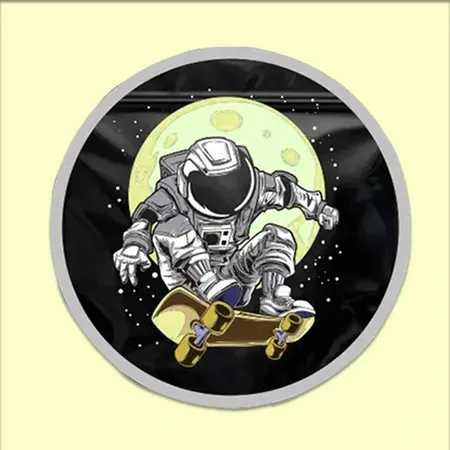
A die cut mylar bag is a flat foil pouch whose outline is cut by a shaped steel die rather than a straight blade. The two bags in our photos show the idea: a round black pouch with an astronaut print and a silver rim, and a panda-shaped sachet for a face mask.
The print goes on first, across the whole sheet. The two panels are sealed together along a path that follows the outline, then the die cuts the bag free a few millimetres outside that seal. The result is a sealed shape with a narrow unprinted or printed border.
They belong to the flat pouch family rather than stand up bags. If you want a shaped front on a bag that stands, ask us about a shaped top on a gusseted pouch instead, or browse the full foil mylar bag range on this site.
Shaped bags earn their place when the pack is the advert. A skincare brand selling sheet masks in a panda or a strawberry outline. A sweet maker putting ten gummies in a heart for Valentine's. A seed company sending a sunflower-shaped packet with a magazine.
They also do well as giveaways at trade shows and in subscription boxes, where a plain rectangle gets lost among everything else in the box.
Almost any closed outline works, with two limits. Inside corners need a radius of at least 5 mm, or the die tears the film instead of cutting it cleanly. Narrow necks, such as the stem of a pumpkin, need to be at least 15 mm wide so the seal fits through them.
Circles and ovals are the cheapest shapes because the die is simple. Characters with ears, legs or antennae cost more to make and fill, since product has to flow into every lobe. Our designers will tell you on the proof where a shape needs simplifying.
Send the outline as a vector file if you can. The guide to artwork and dielines for printed pouches covers the file types and the cut line colour we look for.
Shaped bags hold less than a rectangle of the same width, because the corners are gone. A 100 mm circle holds roughly what a 75 × 95 mm flat sachet holds. Liquids and gels fill a shape well, while chunky products leave empty lobes.
Work from the volume of a single serve. A 25 ml sheet mask essence sits comfortably in a 100 mm shape. Twenty 2 g gummies need about 120 mm across. Send us the product and the weight and we will draw the shape at the right size.
If you are not sure whether a shape or a plain rectangle suits you better, our small printed sachets for single serves are the straightforward comparison.
Most shaped bags use PET / foil / PE, which gives an opaque metal barrier on both panels and takes a deep print. Metallised PET / PE is lighter and a little cheaper, with slightly less barrier. A clear PET / PE back lets the customer see the mask or the sweets from behind.
Face mask essences and sauces need a laminate that does not react with the contents and a seal that holds liquid under pressure in a parcel. Tell us what the product is and we choose the PE sealing layer thickness to suit. Food-contact, high-barrier and compostable film options are available on request and confirmed on the quote.
| Laminate | Back panel | Best for |
|---|---|---|
| PET / foil / PE | Opaque, printed | Face masks, gels, sauces, anything oily |
| Metallised PET / PE | Opaque, printed | Sweets, powders, seeds, promo packs |
| Clear PET / PE | See-through | Gummies and sweets that sell on colour |
| Matte BOPP / PE | Paper-like feel | Short shelf life snacks, event giveaways |
Most die cut bags are single use, so the closure is a heat seal with a tear notch. The notch goes on a straight or gently curved part of the outline where a tear can run cleanly across. We mark it on the proof.
A short press-to-close zipper fits larger shapes with a straight top edge, such as a bottle outline or a rounded rectangle. On a circle there is no straight edge long enough, so a zipper is not practical.
Hang holes fit in a printed tab above the seal, which keeps the shape intact and lets the bag hang on a peg. Round euroslot holes are available on request.
Because the outline is the design, full colour digital print is the usual choice, with a white under-print beneath the colours on foil. Spot gloss over matte makes eyes, logos or droplets stand out on a character shape. A metallic effect border, like the silver rim in our photo, comes from leaving the foil unprinted around the edge.
Artwork needs 3 mm of bleed beyond the cut line on every side, because the die can drift by a millimetre or so. Keep text at least 5 mm inside the cut line and off the seal path. Upload your logo via Design Your Pouch and see a layout before you commit.
Shaped bags arrive with a filling gap left open in the seal, usually at the top of the shape. The steps below are for hand filling with a bench sealer, which is how most small brands start.
The common fault is a shape with thin parts. A unicorn horn 8 mm wide cannot be sealed and filled, so it ends up empty and floppy. Widen the thin parts or drop them.
Another is placing a barcode on a curve. Scanners need a flat, straight code. Put it on the back panel in the widest part of the shape.
A third is expecting a shaped bag to stand. It will not. If the product must stand on a shelf, a stand up pouch with a shaped window is the better route. Our printed pouches for bath salts and scrubs show how a shaped window on a standing bag looks.
Email or WhatsApp the outline, the product, the fill weight per bag and a rough quantity. Quantities are quoted per order, from £0.25 per unit, and the written quote confirms the price including the cutting die.
Our designers send a free proof with the cut line, the seal path and the notch position marked. Once you approve it, production takes 4–6 business days and delivery is free and tracked to any UK address in 2–3 business days.
Misprints or damage reported within 10 days with photos are reprinted or refunded. Start with the written quote request for shaped pouches and attach your outline.
Four short steps: pick a real pouch photo, place your logo on it, choose the colour and finish, and send it. Our designers turn it into a free print-ready proof.
Fill weight, closure, barrier and quantity decide the price. Send what you know and a packaging specialist comes back within one business day with a written quote and a free design proof.
| Price | Quoted per order, from £0.25 a pouch |
|---|---|
| Proof | Free, before anything is printed |
| Production | 4–6 business days after proof approval |
| Delivery | Free and tracked across the UK, 2–3 business days |
| Materials | Food-contact, high-barrier and compostable film options available on request |
Something else? Call +44 7578 382054, message us on WhatsApp or email info@shopmylarbags.co.uk.
The die is priced on your quote with the bags. We tell you the figure before you approve anything, and the die is kept for your repeat orders.
Yes. Circles are the simplest and cheapest shape to cut and seal. A 100 mm circle is a common size for masks and sweets.
The seal runs a few millimetres inside the cut edge and follows the shape. Very tight curves are smoothed slightly so the seal stays continuous.
Most are single use with a tear notch. A short zipper fits shapes with a straight top edge of at least 60 mm.
Yes. Front and back print is standard, and the back is where the barcode and ingredients usually go.
Keep every part at least 15 mm wide so the seal fits through it, and give inside corners a radius of 5 mm or more.
Yes, with a PET / foil / PE laminate and a suitable seal. Face mask essence, sauces and gels are common fills.
Yes. A clear PET / PE back panel lets the sweets or mask show while the printed front carries the design.
No. Die cut bags are flat and lie down or hang from a peg. For a standing bag we suggest a shaped window on a gusseted pouch.
Yes. The hole sits in a printed tab above the seal, so the main shape is not broken.
Yes. One die can serve several artworks, which suits a range of mask types or sweet flavours in the same outline.
Quantities are quoted per order. Tell us the number you have in mind and we quote that figure and one or two alternatives.