Does a flat bottom bag hold more than a stand up pouch at the same height?
Yes. The flat base uses the full width by gusset area, so at equal height a flat bottom bag holds about 15 to 25 percent more.
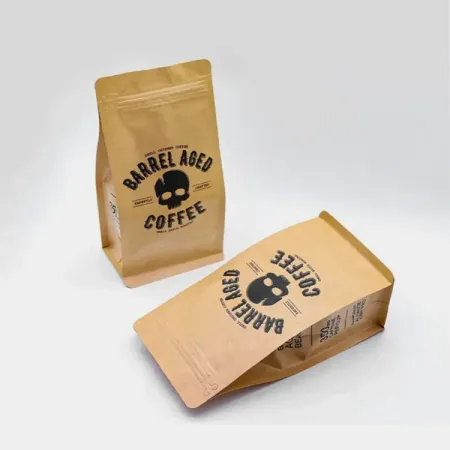
Three box-shaped bags with a flat base and four printable sides. They stand square on a shelf, hold 250 g to 5 kg and give you more print area than any stand up pouch.
3 productsQuoted per order, from £0.25 a pouchFree design proofFree tracked UK delivery
All three stand like a small box. The difference is where the seals run and how the base is formed.
A flat bottom bag has a separate base panel folded in, with side gussets, so it sits flat and square. A quad seal bag has four vertical seals, one at each corner, and a pinched or sealed base. A side gusset bag is the oldest of the three: a tube with two gussets, sealed at the bottom and often closed with a tin tie.
If you are not sure which to pick, the table below is the short answer.
| Pouch | Best for | Key detail |
|---|---|---|
| Flat Bottom Pouches | Coffee 250 g to 1 kg, granola, premium pet treats | Flat base panel, side gussets, zipper and valve possible |
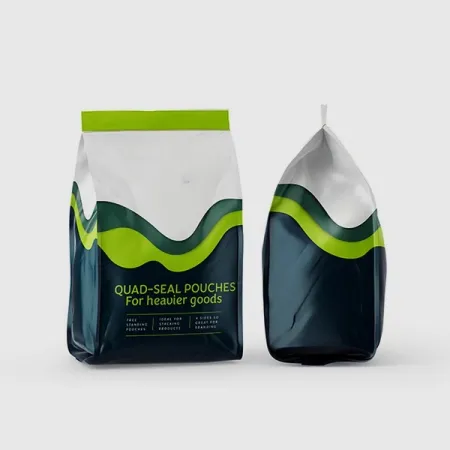
| Quad Seal Bags | Protein 1 kg to 5 kg, dog food, flour, rice | Four corner seals give a stiff, square bag that stacks |
| Side Gusset Bags | Coffee for cafes, bulk tea, bakery flour | Tube with two gussets, no zipper, often a tin tie or heat seal |
Coffee roasters moved to flat bottom bags because the front panel stays flat for print and the bag stands square on a cafe shelf. A 250 g flat bottom coffee bag with a valve is now a standard order.
Pet food brands and protein companies use quad seal bags for 2 kg to 5 kg fills. The corner seals keep a heavy bag rigid, so it does not slump in a carton or on a pallet.
Bakeries, mills and tea wholesalers stay with side gusset bags for bulk packs where a zipper is not needed. The flat bottom pouches with a flat base panel cover the first of these groups.
These bags are measured as width × height + side gusset, in millimetres. The base is the width by the gusset, so a 130 × 80 mm base comes from a bag 130 mm wide with 80 mm gussets.
Because the base is flat, these bags hold more per millimetre of height than a gusseted pouch that tapers at the foot. Treat the sizes in this table as a first guess for coffee beans and kibble, then weigh a sample into a test bag.
| Fill weight | A common size (W × H + gusset) | Typical product |
|---|---|---|
| 250 g | 95 × 215 + 60 mm | Coffee beans, premium treats |
| 500 g | 120 × 250 + 80 mm | Coffee, granola, tea |
| 1 kg | 140 × 300 + 90 mm | Coffee, protein, kibble |
| 2 kg | 180 × 340 + 110 mm | Protein, dog food, flour |
| 5 kg | 250 × 450 + 140 mm | Bulk kibble, rice, flour |
A 250 g coffee bag runs at 110 to 120 microns. A 5 kg quad seal bag of dog food needs 140 to 180 microns, or it tears at the corner seals when lifted.
PET / foil / PE is the barrier choice for coffee and anything with fats, because it blocks oxygen and light. Kraft / PET / PE suits flour, oats and tea sold on a natural look. Metallised PET / PE sits between the two on cost and barrier.
For pet food, the inner PE layer should be thick enough to resist fat from kibble, which can soften a thin sealant. Food-contact, compostable and higher barrier films can be added as options on request. The guide to barrier films and laminates explains what each layer is doing.
A flat bottom bag gives five faces for print: front, back, two gussets and the base. The front stays flat when filled, so a logo does not distort the way it can on a stand up pouch.
The bag also stands straighter. Twelve bags on a shelf line up like books. A one-way degassing valve sits on the back or a gusset, where it does not interrupt the front design.
Zippers run across the top of the front panel, below a tear-off strip. The coffee bag valve and degassing guide covers where to put the valve on this shape.
Choose a quad seal bag once the fill passes 1 kg. The four corner seals act like the edges of a box, so the bag holds its shape full and stacks on a pallet without slumping.
Protein brands like them because a 2.5 kg tub can be replaced with a 2.5 kg bag that uses a fraction of the material. Pet food brands like them because they stand on a shop floor.
A slider zipper suits a wide quad seal bag better than a press-to-close zipper, as it is easier to run along 250 mm of opening. The quad seal bags with four corner seals are offered with either.
A side gusset bag is the traditional coffee bag. It is a tube of film with a gusset folded into each side, sealed at the base. It is filled from the top and closed with a heat seal, a fold and a tin tie, or a label.
There is no zipper, so the unit cost is lower than a flat bottom bag of the same size. Cafes buying 1 kg of beans a week and bakeries buying flour do not need a zipper.
A valve can still be fitted. The side gusset bags with a tin tie page shows the fold-over closure on a kraft bag.
Flat bottom and quad seal bags take a press-to-close or slider zipper under a tear strip. Side gusset bags are heat sealed or folded and tied.
A one-way degassing valve fits any of the three for roasted coffee. A carry handle can be punched through the top seal of a quad seal bag over 2 kg.
A window is possible on the front panel of a flat bottom bag, which pet treat brands use to show the product. Keep the window off the gussets, where the film folds.
Zipper position matters on a box-shaped bag. It sits 20 to 30 mm below the top edge, with the tear strip above it. That leaves a 10 to 15 mm band for your top seal after filling, which a bench sealer or a line jaw both manage.
A flat bottom bag prints front, back, both gussets and the base. The dieline is one flat sheet with the panels marked, and our designers lay your artwork across it for free.
Gussets are narrow, often 60 to 90 mm, so keep text there simple. Brand name on one gusset, roast notes or feeding guide on the other.
Full colour digital or plate print both work. Matte and soft touch finishes are common on coffee, gloss on pet food. White under-print goes under colours on kraft or foil.
Heavy bags fail at the seals, not the print. Under-specified film on a 5 kg bag and a press-to-close zipper on a wide opening are the two errors we see most.
The other mistake is designing the front without allowing for the gusset fold. A logo placed too close to the edge wraps around the corner.
Tell us what goes in the bag, how much per bag and how many bags, plus any valve, zipper, handle or window. If you have a bag you like, measure its width, height and gusset.
Quotes start from £0.25 per unit and are given in writing, with the quantity stated per order. The free design proof is laid out on the five-panel dieline.
After approval, allow 4 to 6 business days for production, then 2 to 3 business days for free tracked delivery to your UK address. Damage or misprints reported with photos within 10 days are put right with a reprint or refund.
Four short steps: pick a real pouch photo, place your logo on it, choose the colour and finish, and send it. Our designers turn it into a free print-ready proof.
Fill weight, closure, barrier and quantity decide the price. Send what you know and a packaging specialist comes back within one business day with a written quote and a free design proof.
| Price | Quoted per order, from £0.25 a pouch |
|---|---|
| Proof | Free, before anything is printed |
| Production | 4–6 business days after proof approval |
| Delivery | Free and tracked across the UK, 2–3 business days |
| Materials | Food-contact, high-barrier and compostable film options available on request |
Something else? Call +44 7578 382054, message us on WhatsApp or email info@shopmylarbags.co.uk.
Yes. The flat base uses the full width by gusset area, so at equal height a flat bottom bag holds about 15 to 25 percent more.
Yes, on the front panel between the two corner seals. Pet treat brands often use an oval window there.
Bags up to about 5 kg of kibble or flour are practical, around 250 × 450 + 140 mm, with a carry handle.
A side gusset bag is normally heat sealed or tin tied. If you need a zipper, a flat bottom bag is the better shape.
The quad seal bag. Its four corner seals keep the bag rigid so layers stay level.
Yes. The base is one of the five printable panels, though many brands leave it plain or print a batch area there.
Yes. The valve is often placed on the back panel or a gusset so the front design stays clean.
Slightly, because the base panel carries the weight. Expect 110 to 120 microns for 250 g to 1 kg, and 140 or more above 2 kg.
A tin tie is normally fitted to side gusset bags. Flat bottom bags use a zipper instead.
A side gusset bag with a valve, heat sealed, is the usual wholesale pick. For retail, the same 1 kg goes in a flat bottom bag with a zipper. See the coffee bags for roasters page for both.
Yes. Each of the five panels is a separate area on the dieline, so the gussets can carry different text.
It depends on size, but a 250 g flat bottom bag packs flat at about 1 mm thick, so 500 to 1,000 arrive in one carton.