Can a flour bag have a paper outside and still take a zipper?
Yes, kraft / PET / PE laminates have a paper face and a film inside. The zipper welds to the film layer.
Quoted per order, from £0.25 a pouch
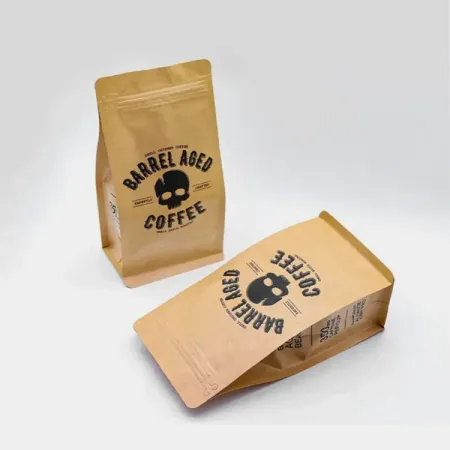
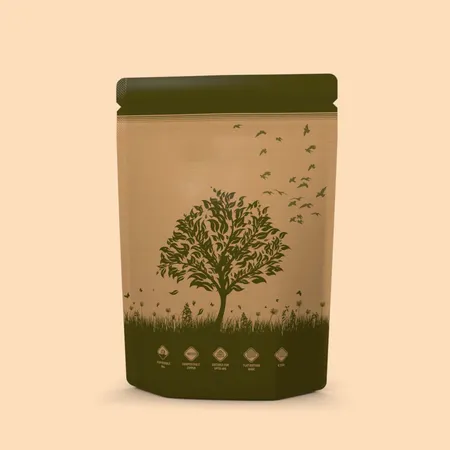
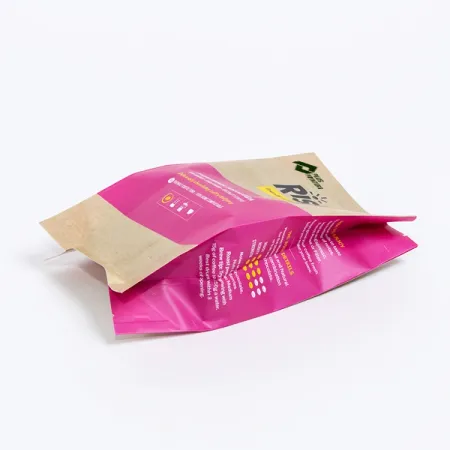
Flat bottom and stand up bags with a zipper for flour, oats, rice, pulses and grains, like the kraft and metallised bags in the photos. Sized to the fill, from a 500 g spice jar refill to a 5 kg bakery sack.
The short version
Flour and dried goods bags are zipper pouches with a moisture barrier, used for flour, oats, rice, lentils, sugar, grains and seeds sold by weight. They come as stand up pouches up to about 1.5 kg and as flat bottom bags with side gussets above that. A kraft paper face gives the traditional mill look while the inner film keeps damp out.
Key facts
| Spec | Standard | On request |
|---|---|---|
| Product | Flour and Dried Goods Bags | Named variants quoted together |
| Range | Pouches by Product | Matching pouches across the range |
| Style and seals | Stand up pouch to 1.5 kg; flat bottom bag with side gussets from 1 kg to 5 kg | Alternatives quoted on request |
| Typical laminate | Kraft / PET / PE, PET / metallised PET / PE, or clear PET / PE with a window | Alternatives quoted on request |
| Typical sizes and fill weights | 500 g about 150 × 230 + 90 mm; 1 kg about 180 × 280 + 100 mm; 1.5 kg flat bottom about 150 × 280 + 110 mm | Alternatives quoted on request |
| Closure | Press-to-close zipper with tear notch, or heat seal only for bakery sacks | Alternatives quoted on request |
| Window | Clear or frosted window option for grains and pulses; none needed for flour | Alternatives quoted on request |
| How it ships | Flat, top open, gussets folded, in cartons | Alternatives quoted on request |
| Sizes | Cut to your fill weight or to the mm dimensions you send | Plain samples in the recommended size before a large run |
| Laminates | PET / foil / PE, metallised PET / PE or kraft / PET / PE, chosen for the product | Clear PET, BOPP or paper-feel films |
| Barrier | Matched to the product and the shelf life you tell us | High-barrier and food-contact film options, confirmed on the quote |
| Closures | Press-to-close zipper with a tear notch | Slider zipper, degassing valve, spout and cap, hang hole |
| Printing | Full colour digital with white under-print on foil and kraft | Plate print for long runs, spot colours and metallic inks |
| Finishes | Matte or gloss | Soft touch matte, spot gloss over matte, metallic effect |
| Windows | None | Clear or frosted, any shape inside the print area |
| Artwork | Vector PDF, AI or SVG placed on our dieline | We rebuild a PNG or JPG logo for print at no charge |
| Proof | Free, before anything is printed | As many revisions as it takes |
| Quantities | Priced for the number you ask for | A price ladder across three quantities |
| Fill weight | Size (W × H + gusset) | Good for |
|---|---|---|
| 500 g flour | 150 × 230 + 90 mm | Speciality and gluten-free flours |
| 1 kg oats | 180 × 280 + 100 mm | Porridge and granola bases |
| 1 kg rice or lentils | 170 × 260 + 90 mm | Dense, packs smaller than oats |
| 1.5 kg bread flour | 150 × 280 + 110 mm flat bottom | Home baking standard pack |
| 5 kg bakery flour | 250 × 450 + 150 mm flat bottom | Wholesale to bakeries and cafés |
Plain paper flour bags are cheap, but they let damp in and flour dust out. Within weeks on a shelf the flour cakes and the bag tears at the corners.
A laminated bag keeps the paper look on the outside and adds a film layer inside. That film holds moisture out, stops dust leaking through the seams and lets the bag take a zipper.
The white and kraft bag in the photos is that type: a paper face over PET and PE. The paper laminate mylar bags page covers the construction in more depth.
Dried goods bags are used wherever something dry is sold by weight. The brands we print for are a mix of producers and retailers.
Smaller fills of 250 g to 500 g, such as speciality flours and spice refills, usually go in a stand up pouch. The kraft stand up pouches with a zipper page lists those sizes.
Flour is light and fluffy straight after milling, then settles. Rice and lentils are dense and settle little. A 1 kg bag for each is a different size.
The table gives sizes with headspace for the zipper. Fine flour needs more room than the weight suggests, because it traps air as it is poured.
Sizes for every weight between 250 g and 5 kg are in the pouch and bag size guide.
| Product | 1 kg bag | Style |
|---|---|---|
| Plain flour | 180 × 280 + 100 mm | Stand up or flat bottom |
| Rolled oats | 190 × 290 + 100 mm | Stand up, oats are bulky |
| Basmati rice | 160 × 250 + 90 mm | Stand up, dense fill |
| Red lentils | 160 × 250 + 90 mm | Stand up, often with a window |
Flour and grains spoil in two ways. Moisture gets in and the product cakes or grows mould, and pantry moths lay eggs in anything they can reach.
A PET / PE film inside the kraft blocks moisture far better than paper alone. A metallised layer, as on the silver pouch in the photos, goes further and also blocks light, which matters for wholemeal flours with their oils.
Food-contact films and a compostable paper-based laminate are options on request, confirmed on the quote. The layers are explained in the laminates and barrier films guide.
Home bakers use a bag of flour over several weeks. A zipper keeps it closed between bakes and stops flour dust spreading through the cupboard.
Trade bags sold to bakeries get emptied into a bin on arrival, so a plain heat seal top is enough and costs less.
The zipper on a 1.5 kg bag needs to be strong, since the bag is lifted by the top. The options are compared on the zipper pouch closures page.
Above 1 kg, a stand up pouch with a rounded base leans and looks untidy on a shelf. A flat bottom bag has a square base and side gussets, so it stands like a box.
It also stacks better in a carton and gives you five panels to print. The kraft bag in the photos is this style, with a zipper and a flat top seal.
Dimensions and gusset depths for 1 kg to 5 kg are on the flat bottom pouches for grains page.
Flour does not need a window; it all looks the same. Red lentils, black rice, mixed beans and rolled oats do sell better when the customer can see them.
A frosted or clear window low on the front panel shows the product without showing dust on the inside of the bag. Shaped windows are an option on request.
Window sizes and positions are set out on the stand up pouches with window page.
Mill and pantry brands tend to print one or two colours on kraft, which looks honest and costs less than full colour. A white under-print lifts a logo so it stays bright on the brown.
Metallised and white films take full colour digital print for brands with photos or illustrations, like the sprouting seedling design on the bag in the photos.
Put the weight, the best before box and the allergen line where a stamp can reach them. Bleed, seal margins and file formats are in the guide to artwork for printed bags.
Flour dust is the enemy of a clean heat seal. Even a thin film of dust in the seal area lets the seal part under the weight of the fill.
Bakery sacks of 5 kg that are not resealed suit a side gusset format with a plain top. See the side gusset bags for flour sacks.
Buying a stand up pouch for 2 kg of flour is the most common one. It leans, falls over and the print creases at the base.
Printing the best before date in the artwork is the second. Use a blank box and a stamp, since the whole run is otherwise dated the same.
Choosing clear film for wholemeal flour lets light reach the oils in the bran, which go rancid faster. For a strong barrier on a smaller pouch, the zip lock foil bags for spices and flours are the alternative.
Tell us the product, the fill weight, whether you want a zipper and a window, and a rough quantity. Each order is quoted separately, from £0.25 per unit, and confirmed in writing.
You get a free design proof showing the gussets, zipper and any window before printing. After approval, bags take 4–6 business days to make.
Delivery is free and tracked to UK addresses in 2–3 business days. Misprinted or damaged bags reported within 10 days with photos are reprinted or refunded. Start on the flour bag quote page.
Four short steps: pick a real pouch photo, place your logo on it, choose the colour and finish, and send it. Our designers turn it into a free print-ready proof.
Fill weight, closure, barrier and quantity decide the price. Send what you know and a packaging specialist comes back within one business day with a written quote and a free design proof.
| Price | Quoted per order, from £0.25 a pouch |
|---|---|
| Proof | Free, before anything is printed |
| Production | 4–6 business days after proof approval |
| Delivery | Free and tracked across the UK, 2–3 business days |
| Materials | Food-contact, high-barrier and compostable film options available on request |
Something else? Call +44 7578 382054, message us on WhatsApp or email info@shopmylarbags.co.uk.
Yes, kraft / PET / PE laminates have a paper face and a film inside. The zipper welds to the film layer.
No. The inner film is welded at every seam, so dust stays inside, unlike a glued paper bag.
Flat bottom bags around 5 kg, roughly 250 × 450 mm with a 150 mm gusset, are the usual upper size. Ask if you need larger.
Yes, a window can be cut in the kraft face with clear film behind it. Keep it low on the front so dust does not settle across it.
The same laminate works, but oat flour is finer and needs the seal area kept clear of dust. The sizes also differ for the same weight.
Yes, the back panel suits a recipe or baking notes. Keep the allergen line and best before box clear of it.
It will hold it, but it leans once half used. A flat bottom bag is steadier at 2 kg.
Yes, the same bags suit any dry flour. Many gluten-free brands use a white or metallised film so the colour stands apart from standard kraft.
A compostable paper-based laminate is an option on request and confirmed on the quote. Standard kraft laminates include a film layer.
Yes, a plain heat seal top is common for bakery bags that are emptied on arrival. It costs less than a zipper.
About 20 percent of the height. Flour traps air as it is poured and settles over the first day.
Yes. Send the product and weights to our packaging team via the contact page and we suggest a style and size.