Pouch guide
Stand Up Pouch Sizes in the UK: Fill Weights and Dimensions
Which pouch size holds 100 g, 250 g, 500 g or 1 kg, the bulk density behind it and how to measure a pouch.
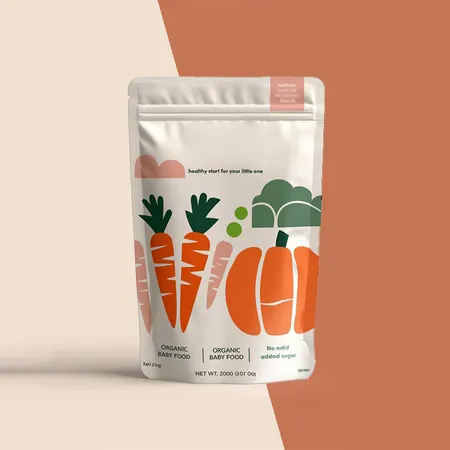
How is a stand up pouch measured?
A stand up pouch is quoted as width × height + gusset, all in millimetres. Width is across the front face, seal to seal. Height is from the bottom of the pouch to the top edge, with the pouch lying flat. The gusset is the depth of the folded base, measured flat before it opens.
So a 160 × 260 + 90 mm pouch is 160 mm wide, 260 mm tall when flat and has a 90 mm base fold. Filled, it stands about 230 mm tall and about 70 mm deep at the foot.
Those three numbers are what you send for a quote. If you only have a pouch you like, lay it flat, empty, and measure all three with a ruler. Do not measure a full pouch, because the gusset has opened and the height has dropped.
Why does the same weight need different pouch sizes?
A pouch holds volume, not weight. A 250 g bag of coffee beans and a 250 g bag of sugar need very different pouches, because beans take up about twice the room per gram.
The figure that links the two is bulk density, in grams per millilitre. Multiply the volume a pouch holds by the bulk density and you get the weight it carries.
Measure your own product with a kitchen jug: fill it to 500 ml, level it, weigh it, and divide by 500. That one number does more for sizing than any chart. The stand up pouch range is sized from it on every quote.
| Product | Bulk density (g per ml) | What 250 g needs (ml) |
|---|---|---|
| Roasted coffee beans | 0.35 to 0.45 | 550 to 700 |
| Ground coffee | 0.40 to 0.50 | 500 to 625 |
| Loose leaf tea | 0.15 to 0.30 | 830 to 1,650 |
| Whey protein powder | 0.45 to 0.55 | 450 to 550 |
| Granola | 0.35 to 0.45 | 550 to 700 |
| Jelly sweets | 0.65 to 0.75 | 330 to 385 |
| Plain flour | 0.55 to 0.65 | 385 to 455 |
| Dry dog kibble | 0.35 to 0.45 | 550 to 700 |
| Freeze dried fruit | 0.10 to 0.20 | 1,250 to 2,500 |
| Bath salts | 1.00 to 1.20 | 210 to 250 |
Which pouch size holds 100 g, 250 g, 500 g and 1 kg?
The list below gives a starting size for roasted coffee beans, the product most UK stand up pouches are ordered for. It assumes a 0.4 g per ml density and leaves room at the top for the seal.
For ground coffee or protein powder, drop one size. For tea, granola or freeze dried food, go one size up. For sweets and flour, the same size holds more weight than shown.
- 50 g: 100 × 150 + 60 mm
- 100 g: 110 × 180 + 70 mm
- 150 g: 120 × 200 + 80 mm
- 250 g: 140 × 220 + 80 mm
- 500 g: 160 × 260 + 90 mm
- 750 g: 180 × 280 + 100 mm
- 1 kg: 200 × 300 + 110 mm
- 2 kg: 250 × 380 + 140 mm
How much headspace does a pouch need?
Film above the product is not wasted. The sealing jaw needs 10 to 15 mm of clean film for the top seal, and the zipper sits 20 to 30 mm below that. The customer needs room to get a scoop in.
On a pouch up to 500 g, leave 30 to 40 mm clear between the fill line and the top edge, and 40 to 50 mm on a 1 kg or 2 kg pouch. That is where the 260 mm height on a 500 g coffee pouch comes from: about 210 mm of product and 50 mm of top.
Products that settle, like ground coffee and powders, look fuller at filling than on the shelf. Fill by weight, not by eye, and expect the level to drop 5 to 10 percent in transit.
How do you work out a size for a product that is not listed?
Use the density method. It takes ten minutes and a kitchen scale, and it beats guessing from a competitor's bag.
The usable volume of a stand up pouch is roughly width × gusset × 0.7 × (height − 40), all in centimetres, which gives millilitres. The 0.7 allows for the oval foot and the tapered top. For a 160 × 260 + 90 mm pouch that is 16 × 9 × 0.7 × 22, about 2,200 ml at the very most, of which you use around 60 percent, so 1,300 ml. At 0.4 g per ml that is 520 g of coffee beans.
Our designers run this for you on request, but it helps to send the density with the brief. A printed stand up pouch to your size is then quoted on the first reply.
- Weigh 500 ml of your product and divide by 500 to get the density.
- Divide the fill weight by the density to get the volume in millilitres.
- Add 30 to 40 percent to that volume for headspace and the foot.
- Pick the nearest size from the list above, or ask us to size it.
- Fill a sample pouch and check the seal area is clear.
What gusset depth should you choose?
The gusset sets how wide the pouch stands. A deeper gusset gives a bigger foot, so the pouch holds more and stands more squarely, but the front face looks shorter once filled.
A gusset of about half the width is the usual rule. A 140 mm wide pouch takes a 70 to 80 mm gusset, a 200 mm pouch takes 100 to 110 mm.
Go deeper for light, bulky products such as tea and granola, where you need the volume. Go shallower for dense products such as sweets and salts, where a wide foot would leave the pouch half empty and slumped.
How do flat bottom and flat pouches compare for the same weight?
Height for height, a flat bottom bag beats a stand up pouch on volume, because its base is a full rectangle rather than an oval. For 250 g of coffee, a flat bottom bag can be about 95 × 215 + 60 mm against 140 × 220 + 80 mm for a stand up pouch.
A flat pouch with no gusset holds much less. The same 250 g of coffee needs a flat pouch of about 160 × 240 mm, and it will not stand.
The choice is not only about volume. Roasters moving to a flat bottom pouch for coffee usually do it for the square shelf presence and the flat front for print.
Which sizes do UK buyers order most?
Retail coffee is 250 g and 1 kg, with 200 g growing among specialty roasters who price by the bag. Tea is 50 g, 100 g and 250 g. Protein is 500 g, 1 kg and 2.5 kg. Pet treats are 100 g to 500 g. Sweets are 100 g to 200 g.
Two sizes cover most brands. A retail size that sells online and in shops, and a bulk size for repeat buyers and trade. Running the same artwork across both saves a second design.
Sizes are made to order, so nothing stops you using 330 g or 1.2 kg if your recipe or price point wants it. The coffee bags for roasters page lists the sizes roasters most often ask for.
What mistakes do brands make with pouch sizes?
The most common one is ordering a pouch from a weight alone, without a density. The second is measuring a full pouch instead of an empty one, which gives a height 30 to 40 mm short.
The third is forgetting that a window, a valve or a zipper takes space. A valve needs a clear area of about 30 mm, and a window should stop 10 mm short of every seal and the gusset fold.
- Sizing from weight without measuring density
- Measuring a filled pouch rather than a flat empty one
- Leaving no headspace for the sealing jaw
- A gusset too deep for a dense product, so the pouch slumps
- A window that runs into the gusset fold
- One size ordered for two products of different density
How do you confirm a size before printing?
Send the fill weight, the density if you have it, and the product name. We suggest a size, and the free design proof shows the artwork on a dieline at those dimensions.
If you want to be certain, ask for a plain sample in that size, fill it, and check the seal area. Print starts only after you approve the proof. Prices start from £0.25 per unit on a written quote, with production in 4 to 6 business days and free tracked delivery across the UK in 2 to 3 business days.