Pouch guide
Choosing a Pouch for Your Food Product
From product to pouch in five decisions: barrier, closure, style, size and print, with worked examples.
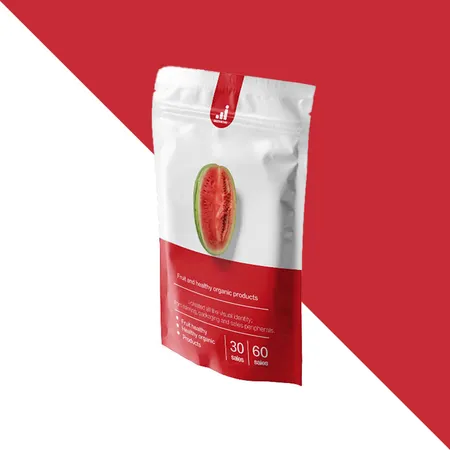
Where do you start when choosing a pouch?
Start with the product, not the pouch. The same pouch that suits one food fails another, and most wrong orders come from copying a bag seen on a shelf.
Five decisions get you from product to pouch: how long it must last, how the customer uses it, where it is sold, how much goes in and how it is printed. Take them in that order, because each one narrows the next.
This guide walks through the five with real numbers. At the end there is a worked example for four common products.
Decision one: how long must it last on the shelf?
Shelf life sets the barrier, and barrier is the most expensive thing to get wrong. Ask what spoils the product first: oxygen, moisture, light or fat going rancid.
Three months or less with no fat or strong aroma, such as pasta, rice or boiled sweets, is fine in a clear or kraft laminate. Six to twelve months with some fat, such as snacks, protein or treats, wants a metallised film. Twelve months or more, or anything with aroma and fat such as coffee, nuts and freeze dried food, wants aluminium foil.
Moisture-sensitive products are a special case. Freeze dried fruit, bath salts and crisp biscuits go soft before they go off, so they need a moisture barrier even for a short shelf life. The barrier films and laminates guide gives the numbers behind each film.
Decision two: how does the customer use it?
Closure follows use. A product finished in one go, such as a single serve or a sample, needs only a tear notch. A product used over days or weeks needs a zipper. A product poured or squeezed needs a spout.
Fresh roasted coffee adds a valve. A product hung on a hook adds a hang hole. A product that is cooked in the pack needs a retort or microwave film and no zipper at all.
Think about hands as well. A 2 kg bag opened every morning wants a slider zipper. A pouch opened on a riverbank with wet hands wants a wide press-to-close zipper and thick film.
| How it is used | Closure | Example |
|---|---|---|
| Eaten or used in one go | Tear notch only | Sample sachet, energy gel, single serve protein |
| Used over days or weeks | Press-to-close zipper | Coffee, sweets, tea, pet treats |
| Opened daily, wide bag | Slider zipper | 2 kg protein, 5 kg kibble |
| Poured, squeezed or drunk | Spout and cap | Sauce, puree, smoothie, bait liquid |
| Packed fresh after roasting | Zipper plus one-way valve | Whole bean and ground coffee |
| Cooked in the pouch | Tear notch, no zipper | Ready meals, rice, wet pet food |
| Sold on a peg hook | Hang hole plus any of the above | Snacks, sweets, seeds |
Decision three: where is it sold?
The shelf sets the style. A product that stands on a retail shelf wants a stand up pouch or a flat bottom bag. A product sold online, by post, wants a flat pouch or a stand up pouch that packs flat in a mailer. A product on a peg hook wants a flat pouch with a hang hole.
A product sold by sight, such as sweets, nuts, pasta and treats, wants a window or a clear panel. A product sold on brand, such as coffee, protein and supplements, wants a full print with no window and a matte or soft touch finish.
Market stalls and farm shops suit kraft and windows. Supermarket shelves suit flat bottom bags that line up straight. Subscription boxes suit flat pouches that post. A stand up pouch with a window covers the first case; a flat bottom bag the second.
- Retail shelf: stand up pouch or flat bottom bag
- Peg hook: flat pouch with a hang hole
- Online and subscription: flat pouch, or a stand up pouch that posts flat
- Market stall: kraft look with a window
- Gift: foil bag, gold or matte black with spot gloss
Decision four: how much goes in?
Fill weight and bulk density set the size. Weigh 500 ml of the product, divide by 500 to get grams per millilitre, and divide your fill weight by that to get the volume the pouch must hold. Add 30 to 40 percent for headspace and the base.
Coffee beans sit around 0.4 g per ml, so 250 g needs about 625 ml plus headspace, which is a 140 × 220 + 80 mm stand up pouch. Jelly sweets at 0.7 g per ml fit 250 g into a pouch a size smaller.
Fill weight also sets the film thickness. Up to 500 g, 90 to 100 microns. From 1 kg to 2 kg, 110 to 120 microns. Above 2 kg, 140 microns or more in a quad seal bag. A quad seal bag for heavy fills is the usual answer above 2 kg.
Decision five: how will it be printed?
Print comes last because it changes the least about how the pouch performs. The questions are run length, number of variants and the look.
Runs of a few hundred to a few thousand, or several flavours in one order, suit full colour digital. Runs in the tens of thousands suit plate print. One or two colour print suits kraft and foil where a simple mark looks right.
On foil or kraft, colours sit on a white under-print layer. Matte, gloss and soft touch finishes are chosen at the quote. Every order gets a free proof from our designers before anything is printed.
How do the five decisions play out for real products?
Four products, five decisions each. The answers are the ones we would give on a first quote, before any sample is weighed.
A specialty coffee roaster, 250 g whole bean, sold online and in cafes, 12 month shelf life. Foil laminate, zipper and valve, flat bottom or stand up pouch, 140 × 220 + 80 mm, full colour matte print.
A dog treat brand, 150 g dried treats, sold at farm shops, 9 months. Metallised laminate with a fat-resistant sealant, press-to-close zipper, stand up pouch with a bone-shaped window, 120 × 200 + 70 mm, kraft look print.
A protein brand, 1 kg whey, sold online, 12 months. Foil laminate at 120 microns, wide press-to-close zipper, stand up pouch, 200 × 300 + 110 mm, matte black with spot gloss.
A fudge maker, 150 g pieces, sold at markets and online, 6 weeks. Clear film or clear front with printed back, heat seal or twist tie, block bottom sweet bag, 100 × 250 mm, printed band at the base. The sweet bags for fudge and pick and mix are made that way.
What mistakes do food brands make choosing a pouch?
Most mistakes come from skipping decision one. A pouch chosen for looks, with the barrier left to chance, costs a reprint when the product goes stale in the shop.
The second group is skipping decision four. A pouch sized by eye from a competitor's bag is either half empty or impossible to seal.
- Choosing the look first and the barrier last
- A window on a product spoiled by light
- No valve on fresh coffee, or a valve on a kraft pouch with no barrier
- A thumb-pressed zipper on a wide, heavy bag that needed a slider
- Sizing from weight without checking density
- One pouch ordered for two products of different density
How do you brief a pouch in one message?
You can send the whole brief in a short message by WhatsApp, email or the quote form. Six lines are enough for a price in writing, which begins at £0.25 a pouch, and a free design proof.
Quantities are quoted per order. Count 4 to 6 business days for production once the proof is approved, plus 2 to 3 business days for the free tracked delivery that covers every UK address. Food-contact, compostable and higher barrier films are options available on request.
- The product and what spoils it first: oxygen, moisture, light or fat.
- The shelf life you need in months.
- How the customer uses it: one go, over weeks, poured or cooked.
- Where it is sold: shelf, hook, online, market or gift.
- The fill weight, and the density if you have measured it.
- The quantity, the number of variants and your logo or artwork.