Is a paper laminate mylar bag made only of paper?
No. Kraft paper is the outer layer, with a PET or foil barrier and a PE sealing layer bonded behind it. The quote states the exact build.
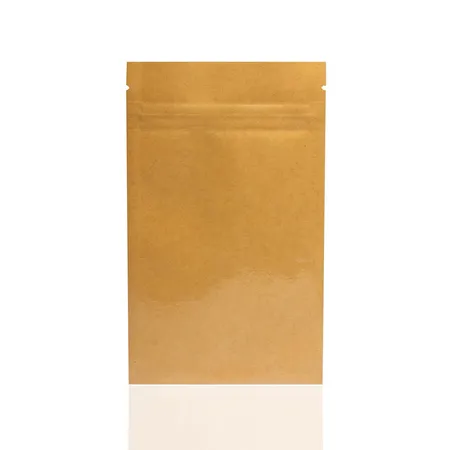
Quoted per order, from £0.25 a pouch
Brown kraft paper on the outside, a foil or metallised barrier on the inside. These are the bags that look like paper on the shelf but keep oats, tea and flour as dry as a foil pouch, with a zipper under the tear notch and a gusset if you want them to stand.
The short version
Paper laminate mylar bags are pouches made from kraft paper bonded to a PET or foil layer and a PE sealing layer. The paper gives the natural look and the inner layers give the barrier and the heat seal. They come as stand up pouches with a gusset or as flat bags, and we confirm the build on a written quote.
Key facts
| Spec | Standard | On request |
|---|---|---|
| Product | Paper Laminate Mylar Bags | Named variants quoted together |
| Range | Foil Mylar Bags | Matching pouches across the range |
| Style and seals | Stand up pouch with bottom gusset, or flat three side seal, heat sealed on the PE layer | Alternatives quoted on request |
| Typical laminate | Kraft / PET / PE for most dry goods; kraft / foil / PE where a longer shelf life is needed | Alternatives quoted on request |
| Typical sizes | Often 100 g to 2 kg; a common size is 180 × 260 + 90 mm gusset for 500 g of oats | Alternatives quoted on request |
| Closure | Press-to-close zipper with tear notch; tin tie or slider zipper on request | Alternatives quoted on request |
| Window | Optional clear strip or shape left in the paper, backed by clear film | Alternatives quoted on request |
| How it ships | Top open, flat packed in cartons, paper side out | Alternatives quoted on request |
| Sizes | Cut to your fill weight or to the mm dimensions you send | Plain samples in the recommended size before a large run |
| Laminates | PET / foil / PE, metallised PET / PE or kraft / PET / PE, chosen for the product | Clear PET, BOPP or paper-feel films |
| Barrier | Matched to the product and the shelf life you tell us | High-barrier and food-contact film options, confirmed on the quote |
| Closures | Press-to-close zipper with a tear notch | Slider zipper, degassing valve, spout and cap, hang hole |
| Printing | Full colour digital with white under-print on foil and kraft | Plate print for long runs, spot colours and metallic inks |
| Finishes | Matte or gloss | Soft touch matte, spot gloss over matte, metallic effect |
| Windows | None | Clear or frosted, any shape inside the print area |
| Artwork | Vector PDF, AI or SVG placed on our dieline | We rebuild a PNG or JPG logo for print at no charge |
| Proof | Free, before anything is printed | As many revisions as it takes |
| Quantities | Priced for the number you ask for | A price ladder across three quantities |
| Fill weight | Size (W × H + gusset) | Good for |
|---|---|---|
| 100 g | 120 × 200 + 70 mm | Loose leaf tea, dried herbs, seeds |
| 250 g | 160 × 230 + 80 mm | Granola, lentils, ground spices |
| 500 g | 180 × 260 + 90 mm | Porridge oats, pasta, sugar |
| 1 kg | 230 × 340 + 120 mm | Flour, rice, dog kibble |
| 2 kg | 280 × 400 + 140 mm | Bread flour, bulk oats, bird seed |
A paper laminate mylar bag is a pouch with kraft paper as the outside layer and a barrier film laminated behind it. The paper you see and touch is real brown kraft. The layer you do not see, PET or aluminium foil, is what stops moisture and air. A PE layer on the inside melts to make the seals.
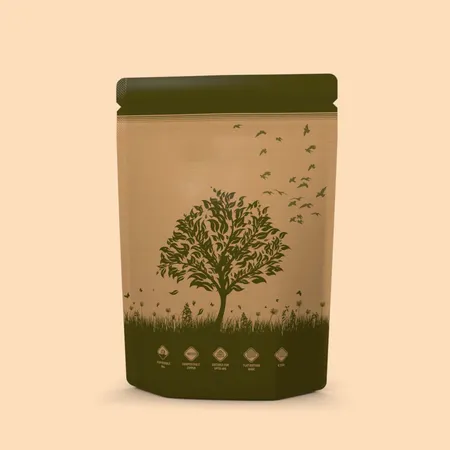
The three bags in our photos show the two shapes we make: a flat kraft bag with a zipper and tear notches, and two stand up versions with a gusset at the base. All of them are plain, which is how many brands order them before adding a label or a one colour print.
Paper alone would let moisture straight through. The laminate is what makes a paper bag behave like a foil one. Our kraft stand up pouches with a window page covers the lighter version with a clear PET backing.
Dry goods with a natural story sell well in paper. A mill in Shropshire bagging 1.5 kg of bread flour wants a bag that looks like it came from a mill. A tea blender wants paper for the same reason. Bird seed, oats, pulses and dog kibble all go in paper laminate bags for the look and the barrier together.
The bags also suit bath and body brands selling bath salts, dried botanicals and soap flakes, where kraft matches the rest of the packaging.
Kraft / PET / PE is the standard build. The PET layer gives a moderate barrier, enough for oats, flour, pasta and pulses that sell within a few months. The bag stays flexible and the paper looks and feels natural.
Kraft / foil / PE puts a thin aluminium layer behind the paper. It blocks light and oxygen as well as moisture, so it suits ground spices, tea with a long shelf life, and anything with oil in it that would go stale in a PET-only bag. The bag is a little stiffer and creases show more.
Food-contact, high-barrier and compostable film options are available on request and confirmed on the quote. If you want the detail on what each layer does, read how barrier films and laminates work before you decide.
| Laminate | Barrier | Suits |
|---|---|---|
| Kraft / PET / PE | Moisture, some oxygen | Flour, oats, pasta, sugar, bath salts |
| Kraft / foil / PE | Moisture, oxygen and light | Spices, tea, nuts, ground coffee, kibble |
| Kraft / clear PET / PE with window | Moisture, light through the window | Granola, rice, seeds that sell on looks |
Oats are light and bulky, so 500 g needs a 180 × 260 mm pouch with a 90 mm gusset. Flour is denser: 1 kg fits a 230 × 340 mm pouch with a 120 mm gusset. Rice and lentils pack tighter still and can go a size down.
Bags above 1 kg need a wider gusset and a stronger seal, because the weight pulls on the base when the customer lifts the bag by the top. We thicken the PE layer on large bags so the seals hold.
Send the product and the fill weight and we size the pouch. The bags for flour and dried goods page lists more sizes for heavy dry products.
Yes. The zipper is sealed to the PE layer on the inside, so it behaves the same as on a foil bag: a press-to-close track below the tear notches, resealed after each use. A tin tie on the top edge is available on request for brands that want the old-fashioned paper bag look.
A window is made by leaving a strip of the paper out and backing the gap with clear film. The window shows the oats or the rice and takes a slice out of the barrier, so keep it modest on products that light spoils. Frosted windows are available too.
Hang holes above the zipper work on smaller bags up to about 250 g. Heavier bags are better stood on a shelf than hung.
Kraft paper is brown, so ink printed straight onto it darkens. One colour print in black, dark green or dark brown looks sharp and natural. White print needs a solid white under-layer or it turns beige. Bright full colour artwork needs a white under-print over the whole print area, which turns the kraft look into a printed label look.
The paper texture shows through the ink, which most brands using kraft want. Matte finish is the natural choice. Gloss on paper looks odd and is rarely asked for.
Our designers take a logo and set it in one colour on the front panel, with the weight and ingredients on the back, and send a free proof. Upload your logo via Design Your Pouch for a kraft preview to see how it sits.
Paper laminate seals the same way as a foil bag, because the seal is made on the inner PE layer. The paper outer needs slightly more heat to push through. These steps suit a bench top sealer or a small filling line.
Yes. Many brands buy plain kraft laminate bags and apply a printed label on the front. The paper takes labels well and the look is consistent with the bag. It is the cheapest way to start, and the bag can be printed later once volumes rise.
Labels do peel at the gusset fold, so keep them on the flat front panel. A stamp with a batch code and best before date on the back works on paper far better than on foil. Our tea pouches for loose leaf blends often start this way.
Choosing kraft / PET / PE for a product that needs a full oxygen barrier is the usual one. Ground coffee, nuts and oily seeds go stale in weeks. Ask for the foil version.
Expecting white ink to print clean without an under-layer is the second. On brown paper, white without a base looks cream. We add the base layer on the proof.
The third is assuming a paper bag is a paper-only bag. Paper laminate bags have film layers inside them. Any claim about what the bag is made of should come from the quote, not from the look of the outside, and compostable or recyclable builds are only ever an option we confirm on request. Our page about how we work explains how quotes and proofs tie the facts down.
Send the product, the fill weight, stand up or flat, and your logo or label artwork. Quantities are quoted per order, from £0.25 per unit, and the written quote confirms the laminate and the price.
Our designers send a free proof of the kraft layout before printing starts. Once approved, production takes 4–6 business days and the bags reach any UK address in 2–3 business days, tracked and free.
Misprints or damage reported within 10 days with photos are reprinted or refunded. Use the quote request for kraft laminate bags and tell us whether you want them plain or printed.
Four short steps: pick a real pouch photo, place your logo on it, choose the colour and finish, and send it. Our designers turn it into a free print-ready proof.
Fill weight, closure, barrier and quantity decide the price. Send what you know and a packaging specialist comes back within one business day with a written quote and a free design proof.
| Price | Quoted per order, from £0.25 a pouch |
|---|---|
| Proof | Free, before anything is printed |
| Production | 4–6 business days after proof approval |
| Delivery | Free and tracked across the UK, 2–3 business days |
| Materials | Food-contact, high-barrier and compostable film options available on request |
Something else? Call +44 7578 382054, message us on WhatsApp or email info@shopmylarbags.co.uk.
No. Kraft paper is the outer layer, with a PET or foil barrier and a PE sealing layer bonded behind it. The quote states the exact build.
No. The film layers behind the paper are continuous, so fine flour stays inside and moisture stays out.
Yes. Kraft / foil / PE adds an aluminium layer for products that need an oxygen and light barrier as well as a moisture barrier.
It can, with a white under-print beneath the colours, but that covers the paper look. One colour print in a dark ink keeps the natural texture.
Yes. The seal forms on the inner PE layer. Set the sealer a little hotter than for plain foil so the heat passes through the paper.
Yes, a tin tie on the top edge is available on request. Most brands choose a zipper, which reseals more tightly.
Natural brown kraft is standard. A white kraft outer is available on request for a lighter look.
Yes. Labels stick well to the paper outer. Keep them on the flat front panel and away from the gusset fold.
Up to about 2 kg with a wider gusset and a thicker PE layer. Tell us the weight and we set the bag to carry it.
The paper surface can show water marks like any paper. Keep filled bags dry in transit and the product inside is unaffected.
Yes. The flat three side seal version with a zipper is shown in our first photo and suits lighter fills up to about 300 g.
Tea, yes, in either build. For ground coffee ask for kraft / foil / PE and a degassing valve, which we can fit to kraft laminate.