What is the smallest printed sachet you make?
Around 50 × 70 mm is a practical minimum once seals and a tear notch are allowed for. Smaller than that, the print area is too tight for a logo and legal text.
Quoted per order, from £0.25 a pouch
Small pouches for one portion: a 12 g coffee, a 10 g tea tasting, a 30 g protein scoop or a 50 g bath soak. Flat or with a small bottom gusset, heat sealed or zipped, printed in your colours and cut to the weight you fill.
The short version
Printed sachets are small flexible pouches, usually under 100 g, sealed on three or four sides and printed with your branding. Most are flat; some carry a small bottom gusset so they stand on a counter. You fill them through the open top and close them on a heat sealer.
Key facts
| Spec | Standard | On request |
|---|---|---|
| Product | Printed Sachets | Named variants quoted together |
| Range | Flat and Three Side Seal Pouches | Matching pouches across the range |
| Style and seals | Three side seal, or four side seal with a small bottom gusset; open top for filling | Alternatives quoted on request |
| Typical laminate | Metallised PET / PE, PET / foil / PE or kraft / PET / PE | Alternatives quoted on request |
| Typical sizes | Often 60 × 80 mm up to 120 × 170 mm, set by the portion | Alternatives quoted on request |
| Closure | Heat seal with tear notch; press-to-close zipper above about 30 g | Alternatives quoted on request |
| Window or valve | No valve; a small clear window on sachets over 80 mm wide | Alternatives quoted on request |
| How it ships | Flat, open at the top, in counted bundles | Alternatives quoted on request |
| Sizes | Cut to your fill weight or to the mm dimensions you send | Plain samples in the recommended size before a large run |
| Laminates | PET / foil / PE, metallised PET / PE or kraft / PET / PE, chosen for the product | Clear PET, BOPP or paper-feel films |
| Barrier | Matched to the product and the shelf life you tell us | High-barrier and food-contact film options, confirmed on the quote |
| Closures | Press-to-close zipper with a tear notch | Slider zipper, degassing valve, spout and cap, hang hole |
| Printing | Full colour digital with white under-print on foil and kraft | Plate print for long runs, spot colours and metallic inks |
| Finishes | Matte or gloss | Soft touch matte, spot gloss over matte, metallic effect |
| Windows | None | Clear or frosted, any shape inside the print area |
| Artwork | Vector PDF, AI or SVG placed on our dieline | We rebuild a PNG or JPG logo for print at no charge |
| Proof | Free, before anything is printed | As many revisions as it takes |
| Quantities | Priced for the number you ask for | A price ladder across three quantities |
| Fill weight | Flat sachet (W × H) | Small stand up (W × H + gusset) |
|---|---|---|
| 5 g to 10 g | 60 × 80 mm | Not offered, too light to stand |
| 15 g to 25 g | 80 × 110 mm | 80 × 120 + 50 mm |
| 30 g to 50 g | 100 × 140 mm | 90 × 140 + 60 mm |
| 60 g to 100 g | 120 × 170 mm | 110 × 170 + 70 mm |
A printed sachet is a small pouch cut and sealed to the size of a single portion, with your branding printed on the face. Front and back are one laminate, sealed on three sides, open at the top until you fill it.
Most sachets are flat. Some carry a small bottom gusset so a 30 g or 50 g sample can stand on a counter display or a shelf edge.
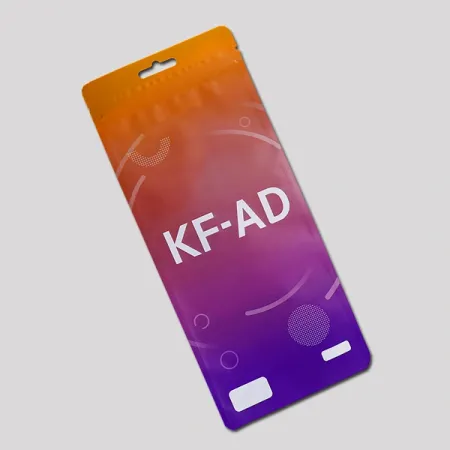
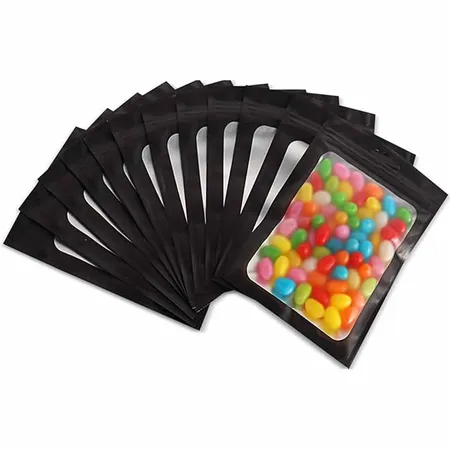
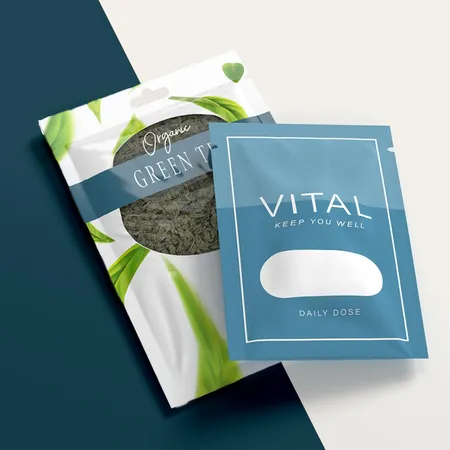
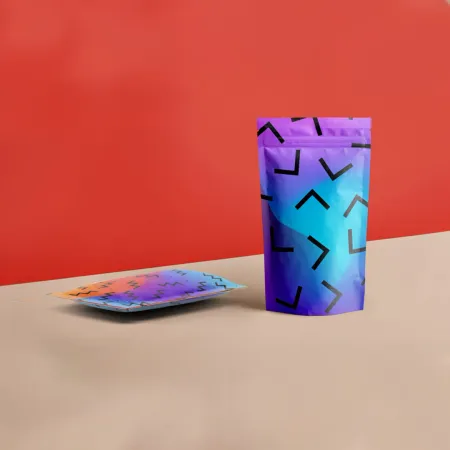
The photos above show both kinds: flat zip sachets in brown and silver film, and a small printed stand up sachet with a zipper across the top. Both sit within our flat and three side seal pouch range, cut smaller.
Sachets do one job well: a single portion that opens once. Trial sizes, sample packs, subscription box inserts and single-serve retail all use them.
A tea blender in Leeds might use 10 g sachets for a tasting flight of six. A protein brand might send 30 g scoops of three flavours before a customer commits to a 1 kg tub.
The full-size version of the same powder usually lives in our supplement pouches for powders and capsules, so the sample and the retail pack can share one design.
Sachet sizes are set by the product's bulk density, not just its weight. Ground coffee takes far more space than the same weight of bath salt, and whole beans more again.
The sizes in the table above are guidance. Send us a fill weight and the product, and we size the sachet to it on the proof.
Density is also what decides whether a stand up form will work. Our guide to UK pouch sizes by fill weight shows how the same weight changes shape from product to product.
Flat sachets are the cheaper and simpler form. They stack in a box, slip into a mailer and use the least film per portion.
A small stand up sachet costs more film and more seal area. In return it stands on a counter, faces forward and carries a zipper comfortably.
If the sachet lives inside another pack or a subscription box, go flat. If it sells on its own at a till, consider the stand up form, or look at our mini mylar bags with a bottom gusset for the foil version.
Small portions have a high surface area for their weight, so the film matters more than it does on a 1 kg bag. Ground coffee in a thin clear sachet loses aroma within days.
PET / foil / PE gives the strongest barrier against oxygen and moisture. Metallised PET / PE costs less and suits most dry samples. Kraft / PET / PE gives a paper look for tea and bath products.
Food-contact, high-barrier and compostable film options can be requested for sachets and are written into the quote. Each layer is explained in our barrier films and laminates guide.
Most sachets are opened once and used up, so a plain heat seal with a tear notch is enough. The notch is a 2 mm cut in the side seal that starts the tear cleanly.
A press-to-close zipper makes sense above about 30 g, where a customer takes two or three servings. Below that weight a zipper takes up a large share of the sachet and adds cost for little use.
Hang holes suit sachets sold on a peg strip near a till. A round hole or a euro slot sits in the top seal, above the zipper if there is one.
| Closure | Suits | Adds |
|---|---|---|
| Heat seal with tear notch | Single portions under 30 g | Nothing; the lowest cost |
| Press-to-close zipper | 30 g to 100 g taken over several servings | Film height and a second seal |
| Hang hole in the top seal | Peg strips at a till | A 6 mm punch with no text above it |
A sachet front can be as small as 60 × 70 mm once seals are taken out. Logos that look fine on a 1 kg bag turn into a smudge at that scale.
Keep body text at 7 pt or larger and give the logo at least 15 mm of width. Full colour digital print handles photographs and gradients; one or two colour print keeps simple marks crisp.
On foil and kraft films a white under-print sits beneath your colours so they stay bright instead of taking on the film's tone. Our artwork guide for printed pouches covers bleed, seal areas and file types.
Sachets are filled through the open top, then closed with a hand sealer, a foot-operated bar sealer or an automatic line. The routine is the same at any scale.
Ordering by weight alone without naming the product. Twenty grams of whole bean coffee needs twice the space of 20 g of fine salt, so the proof shows the wrong size.
Filling sachets right to the top. Product trapped in the seal gives a weak or leaking seal, and the sachet looks bloated.
Choosing a zipper on a 10 g sachet out of habit. It doubles the film area and the customer never uses it.
Forgetting a batch code or best before space. Leave a plain area on the back for a date stamp. If you run form-fill-seal equipment, printed film rolls for sachet machines are the better route than pre-made sachets.
Send the product, the fill weight, flat or stand up, zipper or heat seal, and a rough quantity. Quantities are quoted per order; the price starts from £0.25 per unit and the written quote confirms it for your sachet size.
Our designers set your artwork on the sachet dieline and send a free proof. Nothing is printed until you approve it. Start with the short form above or the full quote request form if you have several sizes.
Once approved, the sachets take 4–6 business days to make. Delivery is free and tracked to any UK address in 2–3 business days, and misprints or damage reported within 10 days with photos are reprinted or refunded.
Four short steps: pick a real pouch photo, place your logo on it, choose the colour and finish, and send it. Our designers turn it into a free print-ready proof.
Fill weight, closure, barrier and quantity decide the price. Send what you know and a packaging specialist comes back within one business day with a written quote and a free design proof.
| Price | Quoted per order, from £0.25 a pouch |
|---|---|
| Proof | Free, before anything is printed |
| Production | 4–6 business days after proof approval |
| Delivery | Free and tracked across the UK, 2–3 business days |
| Materials | Food-contact, high-barrier and compostable film options available on request |
Something else? Call +44 7578 382054, message us on WhatsApp or email info@shopmylarbags.co.uk.
Around 50 × 70 mm is a practical minimum once seals and a tear notch are allowed for. Smaller than that, the print area is too tight for a logo and legal text.
Yes, with a small bottom gusset, usually from about 30 g upwards. Below that weight a sachet is too light and narrow to stand reliably.
Not for single portions. A tear notch and heat seal is enough, and a zipper is worth adding only when the sachet holds several servings.
Yes. Full colour digital print lets several designs share one run, and the quote lists each version.
A hand-held impulse sealer or a small tabletop bar sealer closes the open top. We supply the seal temperature and time with the order.
A PET / foil / PE sachet keeps oxygen and moisture out, which is what ground coffee needs. Nitrogen flushing before sealing helps further on a line.
A clear or frosted window is possible on sachets above about 80 mm wide. On smaller sachets the window leaves little room for print.
Yes, a round hole or a euro slot sits in the top seal. It suits sachets sold on peg strips at a till.
Yes. Kraft or foil sachets for 30 g to 60 g of bath salt or scrub are common, with food-contact and other film options available on request where needed.
Quantities are quoted per order. Tell us the number you need and we price that run, from £0.25 per unit on the written quote.
Production takes 4–6 business days after proof approval, then free tracked delivery in 2–3 business days to any UK address. See the UK delivery details page for how parcels are tracked.
Photograph the fault and tell us within 10 days; we reprint the sachets or refund the order.