Will vacuum seal pouches work on a domestic edge sealer?
Only with an embossed inner layer, which is available on request. Smooth foil pouches need a chamber or nozzle machine.
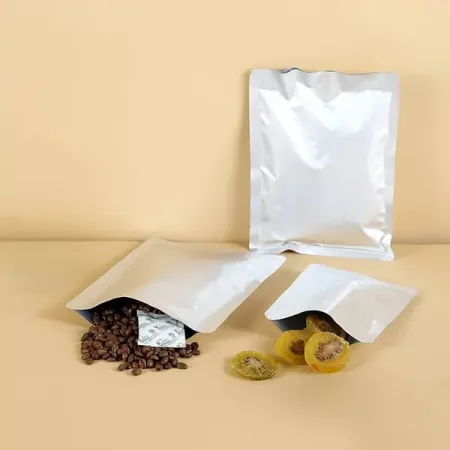
Quoted per order, from £0.25 a pouch
Flat, open-top pouches in PET / foil / PE built to be sealed on a chamber or nozzle vacuum machine. A thicker inner PE layer and the foil barrier hold a hard vacuum without pinholes or slow leaks.
The short version
Vacuum seal pouches are foil laminate pouches with an open top that are filled, placed in a vacuum sealer and sealed with the air removed. The film pulls tight around the product so very little oxygen stays inside. Coffee roasters, dried fruit producers and smokehouses use them for long shelf life.
Key facts
| Spec | Standard | On request |
|---|---|---|
| Product | Vacuum Seal Pouches | Named variants quoted together |
| Range | Flat and Three Side Seal Pouches | Matching pouches across the range |
| Style and seals | Three side seal, open top, sealed under vacuum on your machine | Alternatives quoted on request |
| Typical laminate | PET / foil / PE with a thicker PE layer, about 100 to 140 microns in total | Alternatives quoted on request |
| Typical sizes | Often 150 × 200 mm to 250 × 350 mm, made to your brick or fill | Alternatives quoted on request |
| Closure | Vacuum heat seal; tear notch on request | Alternatives quoted on request |
| Window or valve | No valve; a frosted or clear window on request for cured goods | Alternatives quoted on request |
| How it ships | Flat and open, boxed in counted bundles | Alternatives quoted on request |
| Sizes | Cut to your fill weight or to the mm dimensions you send | Plain samples in the recommended size before a large run |
| Laminates | PET / foil / PE, metallised PET / PE or kraft / PET / PE, chosen for the product | Clear PET, BOPP or paper-feel films |
| Barrier | Matched to the product and the shelf life you tell us | High-barrier and food-contact film options, confirmed on the quote |
| Closures | Press-to-close zipper with a tear notch | Slider zipper, degassing valve, spout and cap, hang hole |
| Printing | Full colour digital with white under-print on foil and kraft | Plate print for long runs, spot colours and metallic inks |
| Finishes | Matte or gloss | Soft touch matte, spot gloss over matte, metallic effect |
| Windows | None | Clear or frosted, any shape inside the print area |
| Artwork | Vector PDF, AI or SVG placed on our dieline | We rebuild a PNG or JPG logo for print at no charge |
| Proof | Free, before anything is printed | As many revisions as it takes |
| Quantities | Priced for the number you ask for | A price ladder across three quantities |
| Fill weight | Size (W × H) | Good for |
|---|---|---|
| 100 g to 150 g | 120 × 180 mm | A sample brick of ground coffee, dried mango |
| 250 g | 150 × 220 mm | The standard retail coffee brick |
| 500 g | 180 × 280 mm | Whole bean coffee, nuts, cured meat portions |
| 1 kg | 220 × 340 mm | Catering coffee bricks, bulk dried fruit |
| 2 kg to 3 kg | 280 × 420 mm | Trade packs for cafes and delis |
A standard flat pouch is built to hold product at normal pressure. A vacuum seal pouch has to hold its shape while the air is pulled out and the film collapses onto the contents.
That takes a thicker inner PE layer, usually bringing the laminate to 100 to 140 microns. The thicker layer resists pinholes from sharp coffee beans and nut edges.
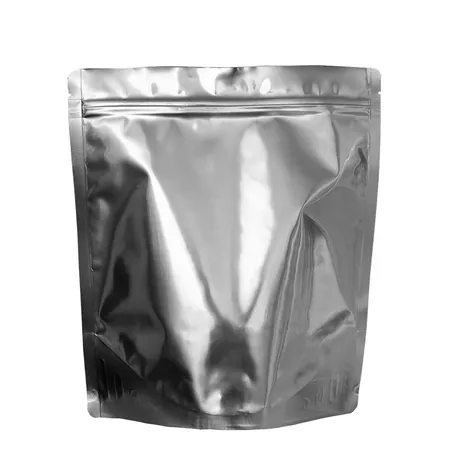
The foil in the middle is what keeps the vacuum. Clear PE bags let oxygen creep back through the film over weeks; foil does not. Our foil mylar bag range uses the same barrier layer in other shapes.
Coffee roasters packing ground coffee into bricks for cafes and supermarkets. The hard brick stacks well and shows the customer that no air has reached the coffee.
Smokehouses and charcuterie makers packing sliced meats and whole pieces. Dried fruit and nut suppliers who want a 12 month shelf life without preservatives.
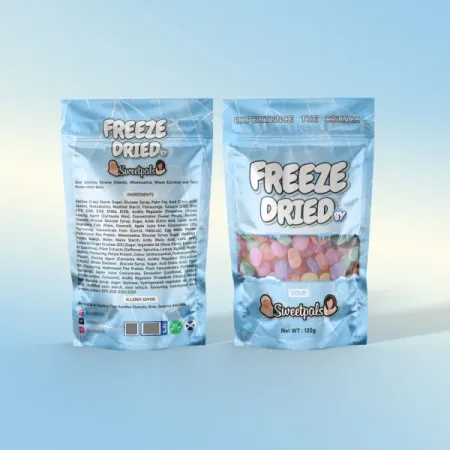
Brands packing lightweight freeze-dried meals often pair these with our freeze dried food bags for long storage, using the vacuum pouch for the dense items.
Most food producers with a vacuum machine own a chamber unit, which suits our standard smooth pouches. Tell us which machine you run and we match the pouch to it.
| Machine | How it works | Pouch requirement |
|---|---|---|
| Chamber vacuum sealer | Whole pouch sits inside a chamber; air is pulled from the chamber, then the bar seals | Smooth inner film is fine; any of our foil laminates work |
| Edge or suction sealer | A channel pulls air through the open top | Needs an embossed or channelled inner layer, available on request |
| Nozzle sealer | A probe enters the pouch, pulls air, withdraws, then the bar seals | Smooth film works; leave extra top length for the probe |
A 250 g ground coffee brick is usually around 110 × 160 × 40 mm once pressed. The pouch needs that footprint plus 20 mm on each side and 60 mm of extra height for the seal and the vacuum draw.
That gives a pouch around 150 × 220 mm, which is why that size is so common. For 500 g go to about 180 × 280 mm and for 1 kg about 220 × 340 mm.
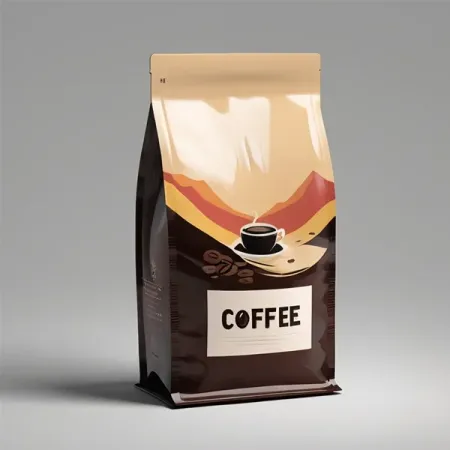
Hard bricks need square corners on the pouch so the film folds neatly. Roasters who also sell beans in a stand up form can match the print to our printed coffee bags for roasters.
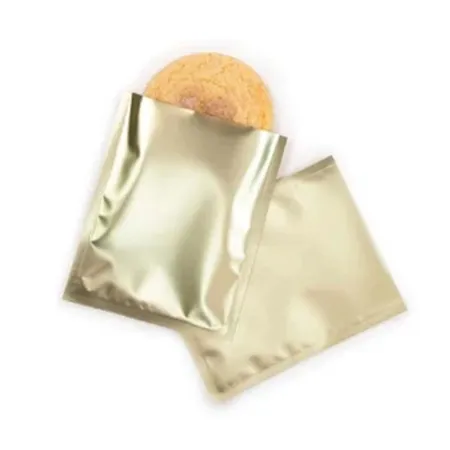
A vacuum removes most of the air, but not all. Oxygen absorber sachets, like the one in the photo above, take care of the oxygen that remains and any that creeps in at the seal.
Nitrogen flushing is the other approach. The pouch is filled with nitrogen before sealing so the product is not crushed, which suits whole bean coffee and crisps better than a hard vacuum.
Either method works with our foil laminate. If you pack coffee within days of roasting, read our coffee bag valves and degassing guide first, since fresh coffee releases gas that a vacuum pouch cannot vent.
A vacuum pouch wrinkles as it collapses, so large flat areas of colour show creases. Keep the main design in the centre of the face and avoid fine lines near the edges.
Many brands print one or two colours on a plain silver or white foil face, then add a label for the variety and date. Full colour print is available where the pouch is the retail pack.
White under-print keeps colours true on silver foil; without it a yellow logo turns olive. Our pouch artwork guide with dieline rules shows where the film will crease.
The steps below suit a chamber machine, which is what most small food producers run. Food-contact and high-barrier film options are available on request and confirmed on the quote before you start.
Pouches that go soft overnight. Nearly always a seal contaminated with product, or a pinhole from a sharp bean or bone edge. A thicker laminate and a wipe of the seal zone fix both.
Film that will not seal. The machine is set for thin PE bags and not for a 120 micron foil laminate, so the seal time needs raising.
Seals that look fine but peel. Too little dwell time, or the seal bar's cover strip is worn.
Bricks with a loose corner. The pouch is too wide for the brick, so the film folds over itself and traps air. A film fault is different, and our reprint and refund terms cover it when reported within 10 days with photos.
A tear notch is sensible on retail packs, since vacuum sealed foil is tough to open. We place it just under the top seal.
A clear or frosted window suits cured meats and cheese, where buyers want to see the cut. Keep the window away from the corners, where the film stretches most under vacuum.
Zippers are not fitted to vacuum pouches. The vacuum would be lost on first opening and the zipper adds thickness in the seal area. If you want a reclosable version without vacuum, our standard three side seal pouches take a press-to-close zipper.
Send the product, your sealer type, the fill weight or brick size, and how many you need. Prices start from £0.25 per unit, and the written quote confirms the figure for your run.
Printed pouches get a free design proof from our team first. Plain silver or white pouches skip that step. Use the short form above or the full quote request form for pouches to include a photo of your current pack.
Production is 4–6 business days after approval, with free tracked delivery to any UK address in 2–3 business days. If pouches arrive misprinted or damaged, photos sent within 10 days get a reprint or a refund.
Four short steps: pick a real pouch photo, place your logo on it, choose the colour and finish, and send it. Our designers turn it into a free print-ready proof.
Fill weight, closure, barrier and quantity decide the price. Send what you know and a packaging specialist comes back within one business day with a written quote and a free design proof.
| Price | Quoted per order, from £0.25 a pouch |
|---|---|
| Proof | Free, before anything is printed |
| Production | 4–6 business days after proof approval |
| Delivery | Free and tracked across the UK, 2–3 business days |
| Materials | Food-contact, high-barrier and compostable film options available on request |
Something else? Call +44 7578 382054, message us on WhatsApp or email info@shopmylarbags.co.uk.
Only with an embossed inner layer, which is available on request. Smooth foil pouches need a chamber or nozzle machine.
Usually 100 to 140 microns in total, with a thicker PE seal layer than our standard flat pouches. We confirm the exact structure on the quote.
You can, but a hard vacuum crushes beans and fresh coffee still releases gas. Many roasters nitrogen flush instead, or use a valve bag for beans.
Not always. For shelf lives beyond a few months, an absorber takes care of the oxygen left after the vacuum.
Not these ones. For cooking in the pouch, look at our retort pouches for heat processed food, which are built for it.
Leave a matte white area on the back for a stamp or thermal label. Printed batch codes change per run, so a label is more practical.
Clear PET / PE vacuum pouches are possible, but they let oxygen through over time. For shelf life beyond a few weeks, foil is the better choice.
It depends on the product, the vacuum level and storage. The pouch removes the oxygen; your product tests set the date.
Yes. Foil laminate stays flexible at freezer temperatures and the seal holds. Keep sharp items padded so frozen edges do not pierce the film.
Yes, one colour, two colour and full colour print are all available. Keep key artwork central because the film wrinkles as it collapses.
Quantities are quoted per order. Send the number you need and we price that run.
Allow 4–6 business days of production after proof approval, then 2–3 business days for free tracked delivery to any UK address.