Can a tea pouch be plain with a label on the front?
Yes, we supply plain matte or kraft pouches you label yourself. Many blenders start that way and move to print once a blend settles.
Quoted per order, from £0.25 a pouch
Matte stand up tea pouches with a tear notch, printed edge to edge in your blend colours. Made to the weight of your leaf, from a 50 g sample to a 500 g catering pack.
The short version
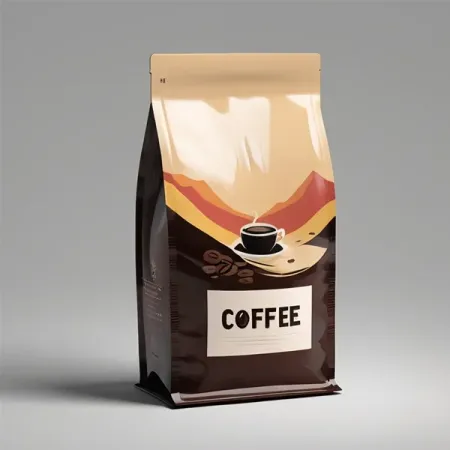
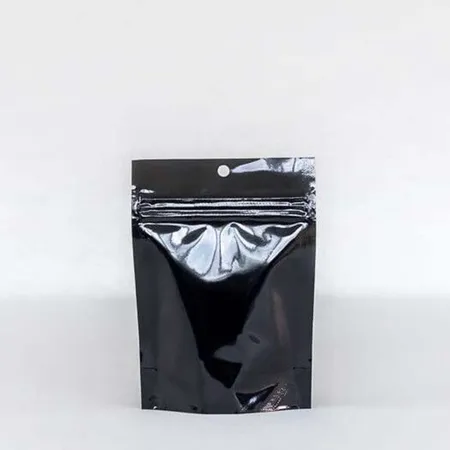
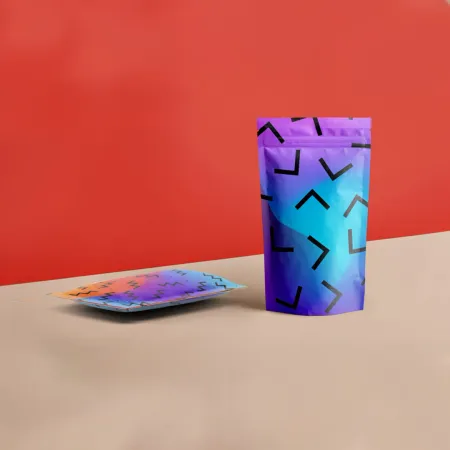
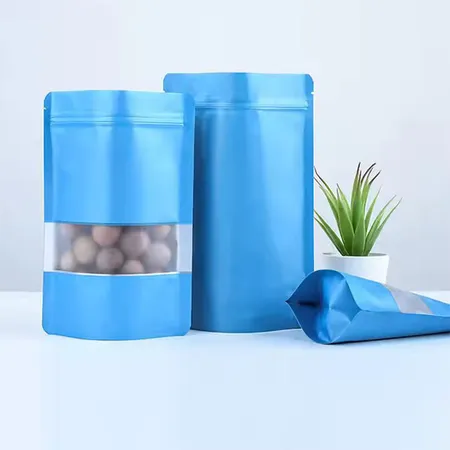
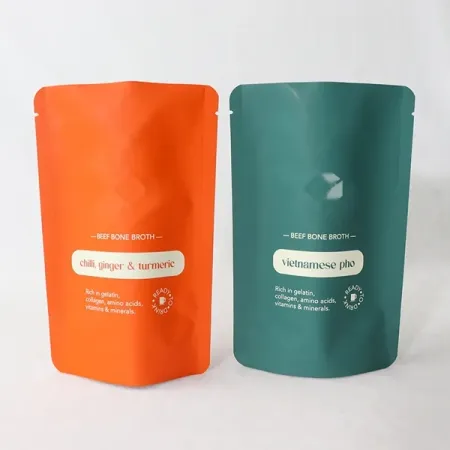
Tea pouches are flexible stand up or flat pouches with a foil or metallised layer that keeps moisture and scent away from dry leaf. They open with a tear notch and can take a zipper for blends sold by the cup. The photos show matte stand up pouches printed in two blend colours.
Key facts
| Spec | Standard | On request |
|---|---|---|
| Product | Tea Pouches | Named variants quoted together |
| Range | Pouches by Product | Matching pouches across the range |
| Style and seals | Stand up pouch with bottom gusset, or flat three side seal for samples | Alternatives quoted on request |
| Typical laminate | Matte BOPP / foil / PE, or PET / metallised PET / PE | Alternatives quoted on request |
| Typical sizes and fill weights | 50 g about 100 × 160 + 60 mm; 100 g about 120 × 200 + 70 mm; 250 g about 160 × 240 + 90 mm | Alternatives quoted on request |
| Closure | Tear notch and heat seal, press-to-close zipper on request | Alternatives quoted on request |
| Window | Frosted or shaped window option for pyramid bags; none for leaf that fades | Alternatives quoted on request |
| How it ships | Flat, top open, in cartons ready for your filling bench | Alternatives quoted on request |
| Sizes | Cut to your fill weight or to the mm dimensions you send | Plain samples in the recommended size before a large run |
| Laminates | PET / foil / PE, metallised PET / PE or kraft / PET / PE, chosen for the product | Clear PET, BOPP or paper-feel films |
| Barrier | Matched to the product and the shelf life you tell us | High-barrier and food-contact film options, confirmed on the quote |
| Closures | Press-to-close zipper with a tear notch | Slider zipper, degassing valve, spout and cap, hang hole |
| Printing | Full colour digital with white under-print on foil and kraft | Plate print for long runs, spot colours and metallic inks |
| Finishes | Matte or gloss | Soft touch matte, spot gloss over matte, metallic effect |
| Windows | None | Clear or frosted, any shape inside the print area |
| Artwork | Vector PDF, AI or SVG placed on our dieline | We rebuild a PNG or JPG logo for print at no charge |
| Proof | Free, before anything is printed | As many revisions as it takes |
| Quantities | Priced for the number you ask for | A price ladder across three quantities |
| Fill weight | Size (W × H + gusset) | Good for |
|---|---|---|
| 50 g loose leaf | 100 × 160 + 60 mm | Sample and tasting packs |
| 100 g loose leaf | 120 × 200 + 70 mm | Everyday retail size |
| 250 g loose leaf | 160 × 240 + 90 mm | Tearoom and café counter |
| 20 pyramid bags | 130 × 200 + 80 mm | Gift and subscription packs |
| 30 g matcha | 90 × 140 + 50 mm | Matcha sold in small amounts |
Tea is dry, light and full of volatile oils. The pouch has to stop moisture getting in and keep the scent of bergamot or jasmine from escaping through the film.
That is why a tea pouch nearly always has a foil or metallised layer, even when the outside is matte and paper-like. A plain clear pouch lets scent and colour fade within weeks.
Shape-wise it is a standard stand up pouch with a bottom gusset. The pouches in the photos are matte laminates with a tear notch and no zipper, which is the simplest tea format. The stand up pouches range shows the other closures available.
Tea pouches are not only for tea merchants. Anyone selling a dry infusion in small weights uses the same format.
Single-serve envelopes for one tea bag or one scoop of chai are a different pouch; those are made as printed sachets for single servings.
Leaf density varies more than most people expect. A rolled oolong is compact, while a whole-leaf white tea or a chamomile flower blend is fluffy and needs a taller pouch for the same weight.
The sizes below suit a typical black or green loose leaf. For light botanicals, go one size up and we confirm the fit on the proof.
Dimensions for every weight from 25 g to 1 kg are listed in the UK stand up pouch sizes guide.
| Fill | Pouch size | Notes |
|---|---|---|
| 50 g black tea | 100 × 160 + 60 mm | Roomy for a flat tasting pack |
| 100 g black tea | 120 × 200 + 70 mm | Standard retail pouch |
| 100 g chamomile | 140 × 220 + 80 mm | Same weight, more volume |
| 250 g black tea | 160 × 240 + 90 mm | Catering and refill packs |
Dry tea absorbs moisture from the air and the leaf goes dull. It also picks up smells, which is why loose tea stored next to coffee tastes of coffee.
Foil laminates give the strongest barrier against both. Metallised PET is a lighter option that still blocks light and most moisture, and it costs a little less per pouch.
Food-contact films are available on request, and a compostable paper-based laminate is an option for brands who want it, both confirmed on the quote. Our plain guide to barrier laminates explains what each layer does.
A tear notch alone suits tea that is decanted into a caddy at home. The customer tears the top, pours the leaf out and the pouch is done.
A press-to-close zipper suits teas used a spoonful at a time, like matcha or a sleep blend. The zipper sits below the tear notch, so the first opening is still clean.
A slider zipper is rarely used on tea, because the pouch is too small for it to look right. Zippers add a little to the cost and about 15 mm to the pouch height. If most of your range is resealed, see the resealable zipper pouches for dry goods.
Tea leaf fades in light, so a full window is rarely a good idea on loose leaf. A small frosted window works for pyramid bags, where the bag itself protects the leaf.
Shaped windows, a teapot or a leaf outline, can be cut on request and sit anywhere on the front panel. We show the size on the proof.
For blends with whole flowers, such as rose or cornflower, a window sells the product. The stand up pouches with a window page shows the shapes we cut.
Matte film is the usual choice for tea because it photographs well and feels soft in the hand. Soft touch matte goes one step further and suits a higher price point.
Deep solid colours, like the orange and green pouches in the photos, need a white under-print so the colour stays bright over the foil. We handle that during layout. Gold or copper foil-effect lettering is an option on request and suits a black or deep green pouch.
Keep the brewing instructions large enough to read, and leave the lower back panel for ingredients and a best before box. The artwork guide for pouch printing lists bleed and seal margins.
Loose leaf breaks if it is forced through a narrow mouth. These steps keep the leaf whole and the seal area clean.
If you are unsure which pouch suits a new blend, our guide to choosing a pouch walks through the decision.
Ordering a pouch for 100 g of black tea and then filling it with 100 g of fluffy herbal leaf is the usual mistake. The pouch will not close.
Skipping the white under-print on a dark foil pouch is another. Pastel colours go muddy without it.
Printing a window on a leaf that fades leads to a tired-looking shelf within a month. Choose a solid panel, or a dark pouch such as the matte black stand up pouch, and put a photo on the front instead.
Tell us the blend, the fill weight, the finish and whether you want a zipper. Prices run from £0.25 per unit and every order is quoted in writing with its own quantity.
A free design proof follows, showing the tear notch, seal lines and any window. After approval the pouches take 4–6 business days to make and travel free with tracking to UK addresses in 2–3 business days.
Misprints or damage reported within 10 days with photos are reprinted or refunded. Send the brief through the tea pouch quote form or by WhatsApp.
Four short steps: pick a real pouch photo, place your logo on it, choose the colour and finish, and send it. Our designers turn it into a free print-ready proof.
Fill weight, closure, barrier and quantity decide the price. Send what you know and a packaging specialist comes back within one business day with a written quote and a free design proof.
| Price | Quoted per order, from £0.25 a pouch |
|---|---|
| Proof | Free, before anything is printed |
| Production | 4–6 business days after proof approval |
| Delivery | Free and tracked across the UK, 2–3 business days |
| Materials | Food-contact, high-barrier and compostable film options available on request |
Something else? Call +44 7578 382054, message us on WhatsApp or email info@shopmylarbags.co.uk.
Yes, we supply plain matte or kraft pouches you label yourself. Many blenders start that way and move to print once a blend settles.
Around 15 to 20 standard pyramids, depending on how tightly they are packed. We size the pouch to the count you give us.
Not through a foil or metallised laminate. Those layers hold the aroma in and keep other smells out.
Yes, full colour digital print suits short runs of one blend. Quantities are quoted per order and shown on the written quote.
Usually not. A tear notch is enough for a pack finished in a few brews, and it keeps the pouch smaller.
Yes, the back panel is the usual place for brewing notes, ingredients and a best before box. Our designers lay it out for you.
Matte and soft touch matte both hide marks well. Gloss shows fingerprints on dark colours.
Yes, with digital print the design can change between blends in the same run. Pouch size and finish stay the same.
No. Tea does not release gas like roasted coffee, so a valve is not fitted.
Small pouches for around 20 g to 30 g, roughly 80 × 130 mm, are common for matcha and samples. Anything smaller is better as a sachet.
Yes, the bottom gusset opens when filled and the pouch stands on its own. Fill to at least two thirds so it does not lean.
Photograph the problem and report it within 10 days. We reprint or refund, as set out on our reprints and refunds page.